Your Team May Feel Unsafe Even When You Understand Psychological Safety
You understand that psychological safety matters.
You encourage your employees to share ideas, ask questions, admit mistakes, challenge decisions, and speak honestly. You remind everyone that their opinions matter. You want people to feel comfortable bringing problems to your attention rather than hiding them until they become bigger.
Yet something still feels missing.
People hesitate before speaking. Meetings remain quiet. Employees wait for your approval before making decisions. Team members agree with you publicly but express their concerns privately. Even when you ask for honest feedback, you sometimes receive polite answers instead of the conversations you hoped to create.
You might find yourself wondering:
Why isn't my team speaking up when I've already told them they can?
This is a question worth exploring.
A leader can understand psychological safety intellectually and still struggle to create it consistently through their behavior. They can know all the right leadership principles but find it difficult to practice them when they feel challenged, disappointed, uncertain, or under pressure.
For example, you might tell your employees that feedback is welcome, but become defensive when someone questions your decision. You might encourage independent thinking but feel uncomfortable when an employee takes a different approach. You might say mistakes are part of learning, yet visibly express frustration when something goes wrong.
These moments matter.
People don't experience leadership only through the words leaders use. They also experience it through reactions, decisions, expressions, communication patterns, and the way leaders respond when situations become uncomfortable.
This brings us to an important distinction: psychological safety vs emotional safety.
Psychological safety helps us understand the conditions people need to speak up, contribute, learn, and take interpersonal risks without unnecessary fear of humiliation or punishment.
Emotional safety in leadership, as explored through Emotionally Safe Leadership™, adds another perspective. It examines the internal emotional patterns that may influence how leaders behave and whether they can consistently create those conditions for others.
Neither concept replaces the other.
In fact, understanding both can help us examine leadership more completely.
Because perhaps the question isn't only whether your employees feel safe enough to speak.
Perhaps we should also ask:
What happens inside you when they actually do?
What Is Psychological Safety?
Psychological safety is a shared belief among members of a team that they can take interpersonal risks without fear of punishment, humiliation, or rejection.
The concept is widely associated with the research of Amy Edmondson. Her work helped establish psychological safety as an important factor in team learning and organizational effectiveness.
In simple terms, psychological safety means people believe they can speak honestly without putting their professional relationships or standing at unnecessary risk.
Think about an ordinary team meeting.
An employee notices a problem with a proposed strategy. They aren't completely certain their observation is correct, but they believe it is important enough to share.
In a psychologically safe environment, they can raise the concern, explain their reasoning, and ask questions without expecting humiliation.
The leader may disagree. The team may challenge the employee's interpretation. The conversation may become uncomfortable.
But disagreement does not automatically become personal rejection.
That's the important distinction.
What Does Psychological Safety Allow Employees to Do?
When people experience psychological safety, they are more likely to:
Ask questions when they don't understand something.
Admit mistakes without automatically hiding them.
Raise concerns before problems become serious.
Challenge assumptions and decisions respectfully.
Offer ideas that differ from the majority.
Ask colleagues for help.
Share information about risks.
Participate honestly in discussions.
Learn from unsuccessful attempts.
Take appropriate interpersonal risks.
These behaviors matter because organizations depend on information.
If employees believe that speaking honestly will damage their reputation, they may choose silence instead. As a result, leaders may receive incomplete information, problems may remain hidden, and teams may miss opportunities to improve.
Imagine an employee who notices a mistake in a financial report but is afraid to question a senior manager. The information exists, but the organization cannot benefit from it if the employee doesn't feel able to raise it.
Psychological safety helps create conditions in which that information can be shared.
Does Psychological Safety Mean Everyone Must Feel Comfortable?
No.
This is one of the most common misunderstandings.
Psychological safety doesn't mean everyone agrees, nobody experiences discomfort, or employees can avoid accountability.
A psychologically safe team can still have:
High performance expectations.
Direct feedback.
Difficult conversations.
Healthy disagreement.
Clear boundaries.
Professional standards.
Consequences for irresponsible behavior.
The goal isn't to remove every uncomfortable experience.
It's to make sure people can participate, question, learn, and contribute without unnecessary interpersonal fear.
Psychological safety does not mean people never feel uncomfortable. It means they can take interpersonal risks without unnecessary fear of humiliation or punishment.
This distinction is essential because effective leadership requires both openness and accountability.
What Is Emotional Safety in Leadership?
Emotional safety has different meanings across psychology, relationships, and workplace discussions. It is important not to assume that every researcher or practitioner uses the term in exactly the same way.
Within the Emotionally Safe Leadership™ philosophy, emotional safety is a specific leadership lens.
It examines how leaders relate to their own emotional experiences and how their internal patterns may influence the emotional environment they create for others.
The central idea is simple:
A leader's ability to create safety for other people can be influenced by how they respond when their own sense of safety is challenged.
For example, how do you react when:
Someone questions your authority?
An employee makes a mistake?
Your decision receives criticism?
You lose control of an important situation?
A colleague disagrees with your approach?
Someone else receives recognition?
You need to ask for help?
You face an uncertain outcome?
These experiences can activate emotional responses that influence leadership behavior.
A leader who experiences disagreement as a threat may become defensive. A leader who feels responsible for preventing every mistake may become controlling. A leader who associates vulnerability with weakness may avoid showing uncertainty.
These reactions don't necessarily mean the leader has bad intentions.
They may reflect protective patterns developed through previous experiences, beliefs, responsibilities, and expectations.
Within Emotionally Safe Leadership™, emotional safety has two connected dimensions.
1. Internal Emotional Safety
Internal emotional safety concerns a leader's ability to remain connected to themselves when facing emotionally challenging situations.
It doesn't mean you never experience fear, frustration, disappointment, or uncertainty.
It means you can recognize those experiences without automatically allowing them to determine your behavior.
For example, imagine an employee questions your decision during a meeting.
Your first reaction might be frustration. You may feel challenged or misunderstood.
Internal emotional safety allows you to notice that response, understand what is happening, and choose how to respond rather than immediately defending your authority.
You can still explain your decision. You can still disagree. But you don't have to turn the conversation into a personal contest.
This capacity matters because leadership involves constant exposure to situations that can challenge confidence, identity, competence, and control.
2. Relational Emotional Safety
Relational emotional safety concerns the emotional experience people have when interacting with a leader.
- Can employees disagree without being humiliated?
- Can they ask questions without being dismissed?
- Can they admit mistakes without being shamed?
- Can they communicate concerns without unnecessary retaliation?
- Can they express uncertainty without being treated as incapable?
These everyday experiences influence how people relate to leadership.
A leader might not intend to create fear. However, repeated defensive reactions, unpredictable communication, excessive criticism, or emotional withdrawal can make people more cautious.
This is why internal and relational emotional safety are connected.
A leader who struggles to tolerate uncertainty may become controlling. A leader who finds criticism threatening may discourage honest feedback. A leader who feels responsible for everyone's happiness may avoid necessary conversations.
Emotional safety in leadership is the ability to remain connected to oneself under emotional pressure while leading in ways that allow others to communicate, contribute, learn, and take responsibility without unnecessary emotional threat.
This is the working definition used within the Emotionally Safe Leadership™ framework, rather than a universal academic definition.
For a deeper explanation, explore What Is Emotional Safety? and Emotional Safety in Leadership
Psychological Safety vs Emotional Safety: The Key Differences
When comparing psychological safety vs emotional safety, it helps to begin with the question each concept asks.
Psychological safety asks:
Do people believe they can speak up, contribute, question decisions, and make mistakes without fear of humiliation or punishment?
Emotional safety in leadership asks:
What happens inside the leader when people speak up, disagree, make mistakes, or challenge something, and how might those emotional patterns influence the experience of being led?
Both questions matter.
One helps us understand the conditions people need to participate. The other helps us examine an important part of what shapes those conditions.
Psychological Safety vs Emotional Safety: Comparison Table
Dimension | Psychological Safety | Emotional Safety in Leadership |
|---|---|---|
Main focus | Shared beliefs about interpersonal risk within a team | Internal emotional patterns and their influence on leadership |
Central question | Can people speak honestly without unnecessary fear? | What happens inside the leader under emotional pressure? |
Primary lens | Team experience and interpersonal dynamics | Leader's internal world and relational impact |
What it examines | Voice, learning, mistakes, disagreement, participation | Emotional responses, identity, beliefs, survival patterns, regulation |
Leadership relevance | How leaders influence conditions for speaking up | Why leaders may struggle to create those conditions consistently |
Desired outcome | Openness, learning, contribution, and team effectiveness | Conscious leadership, healthier relationships, trust, and sustainable team capacity |
Let's explore three important differences.
Difference 1: The Starting Point
Psychological safety starts with the shared experience of people within a team.
It examines whether employees believe they can take interpersonal risks. Can they ask questions? Can they admit mistakes? Can they disagree with a senior colleague?
Emotional safety in leadership begins by examining another part of the picture: what may be happening within the leader.
For instance, a leader might genuinely want employees to challenge decisions. However, if disagreement activates a strong need to defend their competence, they may struggle to respond constructively.
The issue isn't necessarily a lack of leadership knowledge.
It may be an emotional pattern that becomes visible under pressure.
Difference 2: The Question Being Asked
Psychological safety asks:
Do people feel safe enough to speak up?
Emotional safety in leadership asks:
What happens inside the leader when people speak up?
Consider an employee who tells a manager that a project is unlikely to meet its deadline.
The manager has two possible responses.
They can become defensive, blame the employee, and insist that the original plan must continue.
Or they can recognize the emotional discomfort, examine the information, and discuss what needs to change.
The employee's willingness to speak matters. But so does the leader's ability to receive what is being communicated.
Difference 3: The Problem Being Explored
Psychological safety helps us understand the conditions needed for people to participate.
Emotionally Safe Leadership™ explores the emotional patterns that may make those conditions difficult to create consistently.
This distinction is especially useful when a leader has already attended psychological safety training, introduced new communication practices, and encouraged feedback, yet continues to experience silence or dependency within the team.
Perhaps the next step isn't another communication technique.
Perhaps it's examining the emotional patterns beneath the leader's behavior.
Importantly, psychological safety research also examines leadership behavior and interpersonal interactions. The additional contribution of Emotionally Safe Leadership™ is its particular focus on the internal emotional patterns that may influence those interactions.
Are Psychological Safety and Emotional Safety Connected?
Yes. Psychological safety and emotional safety are closely related, but they examine different aspects of the leadership experience.
They shouldn't be treated as competing concepts.
In fact, understanding their relationship can help explain why some leadership initiatives produce limited results.
Imagine a leader who wants employees to communicate more openly.
They introduce a psychological safety initiative. They invite feedback, encourage questions, and tell employees that disagreement is welcome.
At first, the team seems more engaged.
Then an employee challenges one of the leader's decisions.
The leader immediately becomes defensive. They interrupt, explain why their decision was correct, and make it clear that the employee's approach was unnecessary.
Nobody says anything.
The next time the leader invites feedback, the team remains quiet.
What happened?
The leader's stated intention and actual response were different.
The employee received two messages:
The leader says disagreement is welcome.
The leader's reaction suggests disagreement is uncomfortable or unwelcome.
Over time, employees may pay more attention to repeated experiences than to encouraging statements.
This is where the relationship becomes important.
How Emotional Safety May Influence Psychological Safety
We can understand the relationship through a conceptual sequence:
Leader's internal emotional patterns
Beliefs, fears, identity, protective responses
↓
Leadership behavior
Communication, control, delegation, decisions, conflict
↓
Team experience
Trust, pressure, openness, hesitation, confidence
↓
Team psychological safety
Willingness to speak, question, learn, and take interpersonal risks
↓
Team and organizational outcomes
Ownership, collaboration, learning, adaptability, performance
note: This is a conceptual way of understanding influence, not a formula that determines every team's behavior.
Leadership is only one part of the picture. Team relationships, organizational structures, power dynamics, management practices, resources, and wider culture also influence psychological safety.
Still, leaders have an important opportunity: they can examine their own contribution to the environment they create.
Psychological safety and emotional safety are not competing ideas. One helps us understand the conditions people need to contribute. The other helps us examine an important part of what shapes those conditions.
Why Leaders Can Understand Psychological Safety but Still Struggle to Create It
Here's something many experienced leaders eventually discover.
Knowing what good leadership looks like doesn't always mean you can practice it when things become difficult.
You may know that employees need autonomy, but still struggle to delegate. You may understand the importance of feedback, but feel uncomfortable when someone criticizes your decisions.
You may even teach other people to communicate openly while avoiding conversations that make you feel vulnerable.
Why does this happen?
Because leadership behavior isn't influenced by knowledge alone.
It can also be influenced by emotional responses, learned beliefs, identity, expectations, and protective patterns.
Let's look at five examples.
1. You Value Feedback but Feel Threatened by Criticism
You tell your employees that honest feedback helps the organization improve.
But when someone questions your decision, you immediately explain yourself.
You may interrupt, defend your reasoning, or focus on proving that your original decision was correct.
Sometimes, you might even think about the conversation long after it has ended.
What may be happening?
The feedback may be touching something deeper than the decision itself.
Perhaps you associate being wrong with being incompetent. Perhaps your professional identity depends heavily on being seen as capable.
When criticism feels like a threat to your worth, listening becomes harder.
The opportunity is to separate the feedback from your identity.
Someone questioning your decision doesn't automatically mean you're a poor leader.
2. You Encourage Ownership but Struggle to Release Control
You want your employees to become independent decision-makers.
You tell them to take initiative and bring solutions rather than waiting for instructions.
But when they make decisions differently from the way you would, you step in.
You correct their approach, take over the task, or ask them to check with you next time.
Eventually, they stop taking initiative.
They have learned that independence is encouraged in theory but uncomfortable in practice.
This pattern can be connected to difficulty tolerating uncertainty.
When you cannot control every outcome, you may feel exposed to mistakes, criticism, or disappointment.
Understanding why delegation feels so difficult can help you examine the emotional patterns that sometimes sit beneath excessive control.
3. You Say Mistakes Are Part of Learning but React Strongly When They Happen
You encourage experimentation.
You tell your team that mistakes are opportunities to improve.
But when a significant mistake occurs, your frustration becomes visible.
Your voice changes. Your questions become sharper. You focus on who was responsible rather than what happened.
The team may conclude that mistakes are acceptable only when they don't create inconvenience.
This doesn't mean leaders should ignore mistakes.
They should investigate problems, establish accountability, and prevent repeated failures.
The difference is whether the response encourages learning or unnecessary shame.
4. You Want Honest Communication but Avoid Difficult Emotions
Some leaders welcome positive feedback but struggle with frustration, disappointment, or disagreement.
They prefer conversations that remain pleasant.
When an employee expresses dissatisfaction, the leader may quickly change the subject, offer reassurance, or attempt to resolve the discomfort before understanding the issue.
This can make people feel that only certain emotions are welcome.
However, healthy communication sometimes requires difficult conversations.
A leader doesn't need to agree with every concern. They need the capacity to hear it without automatically treating discomfort as a problem to eliminate.
5. You Promote Collaboration but Struggle to Depend on Others
You want a collaborative team.
But you find it easier to do things yourself.
You rarely ask for help. You take responsibility for problems that belong to other people. You may even feel uncomfortable when someone else handles an important task.
This can look like exceptional dedication.
Yet over time, it may create a leadership bottleneck.
Employees become dependent, while you become increasingly exhausted.
The deeper issue may be a belief that depending on others is risky.
This is one reason leadership burnout and over-responsibility deserve attention beyond time management.
Knowing what creates psychological safety is not always the same as being emotionally able to practice those behaviors when something triggers you.
The Emotional Safety Paradox: How Leaders Protect Themselves While Making Others Feel Less Safe
One of the most important ideas within Emotionally Safe Leadership™ is that some leadership behaviors may serve a protective purpose.
A leader might micromanage because uncertainty feels difficult.
Another might avoid difficult conversations because disappointing people feels threatening.
Someone else may take on every responsibility because relying on others feels uncomfortable.
From the outside, these behaviors can look like ordinary leadership problems.
But there may be another layer.
The behavior may be helping the leader avoid an emotional experience they don't know how to handle comfortably.
Consider the following examples.
Protective leadership pattern | What it may protect against | What the team may experience |
|---|---|---|
Micromanagement | Uncertainty and fear of mistakes | Lack of trust and independence |
Perfectionism | Shame and fear of failure | Fear of making mistakes |
Over-functioning | Disappointment and letting people down | Dependency and reduced ownership |
Hyper-independence | Vulnerability and disappointment | Distance and limited collaboration |
Emotional suppression | Exposure and vulnerability | Difficulty expressing concerns |
Micromanagement: Feeling Safer Through Control
A leader who micromanages may believe they are protecting quality.
They check every detail, review every decision, and remain involved in tasks that should belong to other people.
Sometimes this behavior comes from high standards.
But it may also be connected to an uncomfortable relationship with uncertainty.
If the leader believes that everything must be monitored to prevent failure, delegation becomes difficult.
The team may experience this as a lack of trust.
Perfectionism: Feeling Safer Through Flawless Performance
Perfectionism can appear to be a strength.
The leader is prepared, organized, and committed to high standards.
However, when perfection becomes a requirement for feeling worthy or competent, mistakes can become emotionally threatening.
The leader may unintentionally create an environment where employees believe they must always get things right.
People then focus more on avoiding blame than learning.
Over-Functioning: Feeling Safer by Being Responsible for Everything
Some leaders become the person everyone depends on.
They solve problems, absorb additional work, anticipate everyone's needs, and make sure nothing falls apart.
They may genuinely care about their team.
Yet their constant involvement can prevent others from developing their own capacity.
Over time, the leader becomes exhausted while the team becomes increasingly dependent.
Hyper-Independence: Feeling Safer by Needing Nobody
Other leaders rarely ask for help.
They prefer to work independently and may find it difficult to receive support.
Their behavior can be connected to previous experiences in which depending on others felt disappointing or unreliable.
However, leadership requires relationships.
When leaders struggle to depend on others, collaboration may become limited.
Emotional Suppression: Feeling Safer by Showing Nothing
A leader may believe that showing emotion weakens authority.
They hide uncertainty, avoid discussing difficult experiences, and maintain a controlled appearance.
Professional composure can be valuable.
But emotional suppression can make honest conversations harder when the leader never acknowledges that something is difficult.
The team may begin to believe that uncertainty, vulnerability, and emotional honesty are unwelcome.
This brings us to a central principle:
The very behaviors leaders use to feel safer can unintentionally make other people feel less safe.
Sometimes the problem isn't that leaders don't care about emotional safety.
It's that their own protective patterns are getting in the way of how they want to lead.
To explore this further, see Why Survival Patterns Become Leadership Patterns.
The Seven Survival-Based Leadership Identities and Their Impact on Safety
The Seven Survival-Based Leadership Patterns™ framework explores how people may develop different protective ways of leading.
These identities aren't personality types, diagnoses, or fixed labels.
They are conceptual patterns that can help leaders recognize the emotional needs and beliefs that may influence their behavior.
A leader may recognize themselves in more than one pattern. The way a pattern appears may also change across situations.
Here are the seven identities and their possible influence on team safety.
Leadership identity | Internal protective need | Possible leadership behavior | Possible team experience |
|---|---|---|---|
Certainty and control | Micromanages and avoids risk | Hesitation and dependence | |
Avoiding disappointment and failure | Rescues and absorbs responsibility | Reduced ownership | |
Avoiding dependence and disappointment | Works alone and struggles to receive support | Limited collaboration | |
Avoiding vulnerability | Suppresses emotions and hides uncertainty | Difficulty expressing concerns | |
Maintaining competence and usefulness | Becomes the answer to everything | Team dependency | |
Demonstrating worth and gaining approval | Over-prepares and over-explains | Pressure to prove competence | |
Maintaining success and progress | Creates urgency and pushes for more | Exhaustion and reduced recovery |
The Protective Leader™
The Protective Leader may seek safety through control, certainty, and prevention.
They want to avoid mistakes and reduce unexpected problems.
Their intention may be to protect the team, but excessive monitoring can limit independence.
Explore The Protective Leader™.
The Responsible Leader™
The Responsible Leader may feel responsible for making sure everyone is supported and everything works.
They take on additional tasks, rescue struggling employees, and struggle to let others experience the consequences of their decisions.
The result can be a team that waits for the leader to solve problems.
Explore The Responsible Leader™.
The Self-Reliant Leader™
The Self-Reliant Leader may find safety in independence.
They trust themselves to get things done but struggle to rely on other people.
This can reduce collaboration and make the leader an isolated decision-maker.
Explore The Self-Reliant Leader™.
The Strong Leader™
The Strong Leader may believe that vulnerability threatens authority.
They maintain composure, hide uncertainty, and avoid showing when something affects them.
Although strength is valuable, refusing to acknowledge difficulty can make emotional honesty harder within the team.
Explore The Strong Leader™.
The Capable Leader™
The Capable Leader may feel valuable when they can solve problems and provide answers.
They become the person everyone depends on.
Unfortunately, this can create a situation where the leader's competence becomes a bottleneck rather than a source of team development.
Explore The Capable Leader™.
The Proving Leader™
The Proving Leader may work hard to demonstrate competence, earn recognition, and show that they deserve their position.
They may over-prepare, over-explain, and struggle when their contributions go unnoticed.
This pressure can also influence how they evaluate the performance of others.
Explore The Proving Leader™.
The Achievement-Driven Leader™
The Achievement-Driven Leader may associate progress with safety and success with personal worth.
They create ambitious goals and push themselves and others toward constant improvement.
The challenge appears when achievement becomes more important than recovery, capacity, and sustainability.
Explore The Achievement-Driven Leader™.
These patterns provide another way to examine the relationship between leadership behavior and psychological safety.
Rather than asking only, "What should I do differently?", leaders can begin asking:
What am I protecting through the way I lead?
You can also explore the complete Seven Survival-Based Leadership Patterns™ framework, or use the Leadership Pattern Comparison Guide to understand the differences.
Emotional Safety, Psychological Safety, and Trust
Psychological safety, emotional safety, and trust are closely connected.
However, they are not interchangeable.
Understanding their differences can help leaders avoid treating every relationship problem as the same issue.
Concept | Core question |
|---|---|
Psychological safety | Can I speak honestly here? |
Emotional safety in leadership | What emotional patterns shape the way leadership feels and how the leader responds? |
Trust | Can I rely on these people to act with honesty, consistency, and responsibility? |
How Are They Different?
Imagine that you work for a manager who is technically excellent.
You trust their knowledge. You believe they can make good decisions, understand the business, and deliver results.
However, you hesitate to disagree with them.
You trust their competence, but you don't feel comfortable challenging their opinions.
This shows why trust and psychological safety are different.
Trust may exist in one area while psychological safety remains limited in another.
Now imagine a manager who encourages open conversations but frequently changes expectations without explanation.
You may feel able to speak up, but struggle to rely on their consistency.
Again, these concepts overlap without being identical.
How Do They Reinforce Each Other?
Healthy leadership relationships require repeated experiences.
People need more than a leader who says they can speak openly.
They need experiences that show their honesty will be treated with respect.
They need leaders who follow through on commitments, communicate consistently, take responsibility, and respond constructively when problems arise.
This is why team trust deserves attention alongside psychological safety.
The broader goal is not simply to make people comfortable.
It is to build relationships where people can be honest, responsible, and dependable.
Emotional Safety, Psychological Safety, and Accountability
One concern leaders sometimes have is that creating psychological safety will lower standards.
They worry that if employees feel too comfortable, they may become less accountable.
But this assumes that safety and accountability are opposites.
They aren't.
A healthy team needs both.
People should be able to raise concerns without unnecessary fear. They should also take responsibility for their work, meet expectations, and correct mistakes.
The difference is how accountability is practiced.
Fear-based environment | Emotionally safer environment |
|---|---|
Mistakes create shame | Mistakes are examined and corrected |
People hide problems | People raise problems earlier |
Disagreement is treated as disrespect | Disagreement can be discussed respectfully |
Leaders rely on excessive control | Leaders establish clear responsibility |
People focus on avoiding blame | People focus on ownership and learning |
Feedback becomes personal criticism | Feedback focuses on behavior and improvement |
Consider an employee who misses an important deadline.
A fear-based response might involve public embarrassment, personal criticism, or immediate assumptions about the employee's character.
An emotionally safer response doesn't mean ignoring the missed deadline.
The leader still needs to understand what happened, establish responsibility, and agree on corrective action.
But the conversation focuses on facts, expectations, and solutions rather than humiliation.
This is where psychological safety and accountability can support one another.
Safety without accountability can become avoidance. Accountability without safety can become fear.
The goal is to create an environment where people can take responsibility without feeling that every mistake threatens their worth or belonging.
For more on this relationship, explore Ownership and Accountability.
What Happens When Psychological Safety Is Missing?
When psychological safety is limited, people may become more cautious about participating.
However, silence doesn't always mean fear. It can also reflect unclear responsibilities, cultural differences, low motivation, limited expertise, power dynamics, or poor meeting design.
The important thing is to avoid diagnosing a team based on one behavior.
Instead, look for repeated patterns.
Common Signs of Low Psychological Safety
1. Employees remain quiet during meetings.
People may have ideas or concerns but decide that sharing them isn't worth the potential interpersonal risk.
2. People hesitate to challenge decisions.
Even when they notice a problem, they may prefer to remain agreeable.
3. Mistakes are hidden.
Employees may delay reporting errors because they fear the reaction.
4. Problems are reported too late.
Information reaches leadership only when the situation has become difficult to ignore.
5. Employees avoid asking questions.
They may worry that questions will make them appear unprepared or incapable.
6. People agree publicly but disagree privately.
Meetings appear peaceful, but important concerns remain outside the conversation.
7. New ideas are rarely offered.
People may decide that suggesting something different creates more risk than value.
8. Employees wait for approval.
They avoid making decisions because they are unsure how leadership will respond.
9. Difficult conversations are avoided.
Problems remain unresolved because people don't believe they can discuss them constructively.
10. People protect their image instead of sharing information.
The team becomes more focused on appearing competent than learning together.
What Should Leaders Ask?
Instead of immediately telling employees to speak more, consider asking:
What happens when someone challenges a decision here?
How do we respond when mistakes occur?
Do employees know which decisions they can make independently?
Are concerns addressed consistently?
Do people receive the same treatment regardless of their position?
Is disagreement treated as useful information?
These questions can reveal more than simply asking whether the team feels safe.
Explore Psychological Safety for a broader understanding of this team and organizational dimension.
What Happens When Emotional Safety Is Missing in Leadership?
When emotional safety is limited within leadership, the consequences may appear at several levels.
The leader's internal experience, their visible behavior, and the team's everyday experience can all be affected.
1. Within the Leader
A leader may experience:
Feedback as a personal threat.
Mistakes as disproportionate failures.
Uncertainty as an urgent problem.
Asking for help as a sign of weakness.
Disagreement as rejection.
Rest as something they must earn.
Performance as the main source of self-worth.
These experiences may influence how the leader approaches responsibility, relationships, and decisions.
For example, someone who believes they must always be capable may struggle to admit that they don't know the answer.
2. Within Leadership Behavior
These internal experiences may appear through:
Micromanagement.
Over-functioning.
Avoidance of conflict.
Defensive communication.
Excessive control.
Emotional withdrawal.
Perfectionism.
Difficulty trusting others.
The leader may not consciously choose these behaviors as a strategy.
They may become automatic responses to situations that feel threatening.
3. Within the Team
Over time, employees may experience:
Dependency.
Reduced ownership.
Hesitation.
Limited collaboration.
Fear of mistakes.
Difficulty raising concerns.
Reduced initiative.
Unclear decision-making authority.
This doesn't mean every instance of micromanagement or perfectionism comes from an emotional survival pattern.
There can be practical reasons, such as inexperienced employees, regulatory requirements, genuine performance problems, or insufficient resources.
The emotional lens is one useful way to explore behavior, not the only explanation.
For a deeper understanding, read Leadership Under Pressure and Emotional Regulation for Leaders.
The Relationship Between the Leader's Inner World and the Team's Experience
Leadership isn't expressed only through conscious decisions and communication techniques.
It is also influenced by repeated emotional and behavioral patterns.
A leader's internal experience may influence what they notice, how they interpret situations, what they consider threatening, and how they respond.
For example, two leaders may receive exactly the same feedback.
One sees an opportunity to improve.
The other interprets the feedback as evidence that their authority is being questioned.
The information is identical.
The internal interpretation is different.
And that difference may influence the next conversation.
How Internal Patterns Become External Leadership Experiences
Consider the following conceptual model.
From Internal Emotional Patterns to Team Experience

1. Leader's internal emotional patterns
Fear, identity, beliefs, expectations, survival responses.

2. Leadership behavior
Control, communication, delegation, decision-making, conflict management.

3. Team emotional experience
Trust, pressure, openness, hesitation, confidence, and perceived support.

4. Team psychological safety
Willingness to speak, question, learn, and take interpersonal risks.

5. Team and organizational outcomes
Ownership, collaboration, learning, adaptability, and performance.
This model helps us think about how internal experiences may influence external outcomes.
It isn't deterministic.
A leader's emotional patterns don't single-handedly determine whether a team has psychological safety. Colleagues, organizational culture, workload, policies, resources, and management systems also matter.
Still, the leader's internal world deserves attention.
Because leadership behavior is not separate from the person practicing it.
For more on this connection, explore Leadership Identity™ and Leadership Beliefs.
The Emotional Safety Transmission Loop™
One way to understand how leadership patterns become reinforced is through the Emotional Safety Transmission Loop™.
This is a conceptual framework for examining how an internal protective response may influence team behavior and then become reinforced by the resulting team experience.
Let's use a leader who struggles to trust others.
How the Loop Develops
Step 1: Internal fear or uncertainty
The leader feels uncomfortable when they cannot control an outcome.
Step 2: Protective leadership behavior
They check everything, monitor employees, and take decisions back.
Step 3: Reduced team independence
Employees become less confident making decisions independently.
Step 4: Increased team dependency
People begin asking for approval more frequently.
Step 5: The leader interprets dependency as proof
The leader concludes that employees cannot take responsibility without close supervision.
Step 6: More control
They increase monitoring and become even more involved.
Step 7: The pattern becomes stronger
The team becomes increasingly dependent, reinforcing the leader's belief that control is necessary.
The Survival-Based Leadership Loop

Internal fear or uncertainty
↓
Protective leadership behavior
↓
Reduced team independence
↓
Increased team dependency
↓
Leader interprets dependency as proof that more control is needed
↓
More control and stronger survival behavior

Self-reinforcing cycle
The leader may believe they are solving a performance problem.
But their response may be helping maintain the very dependency they want to eliminate.
How Can Leaders Interrupt the Loop?
The alternative begins with awareness.
Instead of automatically taking control, the leader can pause and ask:
What am I afraid will happen if I don't intervene?
Is this situation genuinely risky, or simply uncomfortable?
Does this decision belong to me or to someone else?
What support would help the employee take responsibility?
Am I correcting a real performance issue or protecting myself from uncertainty?
A healthier sequence might look like this:
The Conscious Leadership Alternative
- Awareness of the emotional response
- Regulation before reacting
- Conscious leadership response
- Clear authority and expectations
- Shared responsibility
- Greater team capacity
- Increased opportunity for trust
This doesn't mean leaders should never intervene.
There are situations where close supervision is necessary, especially when safety, legal obligations, or significant operational risks are involved.
The point is to make intervention conscious and appropriate rather than automatic.
When a leader changes the way they respond, they create the possibility for the team to respond differently too.
How to Build Both Psychological Safety and Emotional Safety
Understanding the difference between psychological safety and emotional safety is useful.
But understanding alone isn't enough.
Leaders need practical ways to develop both.
The most effective approach is to work on two connected areas: the leader's internal responses and the external conditions experienced by the team.
A. Develop Emotional Safety Within Leadership
Here are eight practical starting points.
1. Identify What Situations Activate You
Notice when your reactions become stronger than the situation seems to require.
Perhaps you become defensive when someone questions your decision. Perhaps you feel frustrated when employees make independent choices.
These moments can provide useful information.
2. Recognize Your Protective Patterns
Do you take over when things become uncertain?
Do you avoid conflict?
Do you feel compelled to solve everyone's problems?
Recognizing repeated behavior helps you understand what may be influencing it.
3. Understand What You Fear Might Happen
Ask yourself what feels threatening about the situation.
Are you afraid of looking incompetent? Losing control? Disappointing someone? Being rejected?
You don't need to judge the answer.
You need to understand it.
4. Notice Emotional Reactions Before Acting
A pause can create room for a more considered response.
When you feel defensive, frustrated, or overwhelmed, notice the emotion before deciding what to do.
5. Practice Responding According to Your Values
Ask yourself what the leader you want to become would do in this situation.
Would they listen first? Ask another question? Set a boundary? Delegate responsibility?
Choose the behavior deliberately.
6. Become More Comfortable With Uncertainty
Not every problem needs an immediate answer.
Some situations require investigation, discussion, or time.
Learning to tolerate uncertainty can reduce unnecessary control.
7. Learn to Receive Feedback
Try listening to the entire message before explaining your position.
You can disagree with feedback without dismissing the person providing it.
8. Develop Healthier Boundaries and Shared Responsibility
You don't need to carry every problem.
Clarify what belongs to you, what belongs to others, and where collaboration is necessary.
B. Create the Conditions for Psychological Safety
Leaders can also take practical steps to improve the team's experience.
Leadership practice | What it helps create |
|---|---|
Respond constructively to concerns | Greater willingness to speak |
Invite different perspectives | More open discussion |
Avoid humiliating people for mistakes | Greater willingness to learn |
Clarify expectations and decision rights | Confidence and independence |
Encourage questions | Better communication |
Listen without immediate defensiveness | More honest conversations |
Separate disagreement from personal rejection | Healthier conflict |
Follow through on raised concerns | Greater credibility |
Maintain clear accountability | Responsibility and ownership |
Model learning and openness | A stronger learning environment |
C. Strengthen the Organizational Environment
There's one more important dimension.
Organizations cannot rely entirely on individual leaders to create psychological safety.
The wider system matters.
Consider whether your organization:
Rewards people for raising problems or punishes them for doing so.
Provides enough resources to meet expectations.
Makes decision-making authority clear.
Supports reasonable workloads.
Handles performance issues consistently.
Encourages respectful disagreement.
Provides managers with the authority to make decisions.
Recognizes collaboration rather than rewarding unhealthy competition.
A leader may genuinely want employees to speak openly, but if the organization punishes people who raise uncomfortable information, their efforts will face serious limits.
Developing emotionally aware leaders and building psychologically safe teams are not separate projects. They are connected parts of healthier leadership.
For further reading, explore Healthy Workplace Culture and Human-Centered Organizations.
How Emotionally Safe Leadership™ Connects the Two
Traditional leadership development often focuses on visible behaviors.
Leaders learn how to delegate, communicate, build trust, provide feedback, resolve conflict, and encourage collaboration.
These skills are important.
But there is another question worth asking:
What emotional patterns make these behaviors difficult to practice consistently?
This is where Emotionally Safe Leadership™ adds another perspective.
It explores the relationship between a leader's internal emotional patterns and their external leadership behavior.
Consider these examples.
Traditional leadership question | Emotionally Safe Leadership™ question |
|---|---|
How do I delegate better? | What am I afraid might happen if I let go of control? |
How do I encourage feedback? | What happens inside me when someone challenges my decision? |
How do I build trust? | Why do I struggle to rely on other people? |
How do I create psychological safety? | What emotional patterns influence how I respond when people speak honestly? |
How do I become more confident? | What am I trying to prove when my confidence feels threatened? |
How do I manage conflict? | What does disagreement mean to me emotionally? |
These questions don't replace leadership skills.
They help leaders understand why applying those skills can become difficult under pressure.
Leadership Is More Than a Collection of Skills
Every leader brings personal experiences, emotional history, beliefs, and protective patterns into their professional relationships.
These may influence:
How they make decisions.
How they respond to criticism.
How they manage uncertainty.
How they delegate responsibility.
How they approach conflict.
How they communicate expectations.
How they respond to success.
How they handle visibility and authority.
Sometimes, the gap between the leader you want to be and the way you actually behave under pressure is not simply a knowledge gap.
It may involve patterns that deserve deeper attention.
This is the central philosophy behind What Is Emotionally Safe Leadership™.
It is also why the principles of Emotionally Safe Leadership™ focus on more than what leaders do.
They invite leaders to understand what influences the way they lead.
The Five Pillars of Emotionally Safe Leadership™
Emotionally Safe Leadership™ extends the conversation beyond how employees experience their team environment.
It also examines how leaders experience themselves, their relationships, their visibility, their success, and their capacity to grow.
Within this philosophy, five pillars provide a broader framework for understanding emotional safety.
1. Self Safety™
The ability to remain connected to your values, boundaries, and sense of worth under pressure.
This pillar explores whether you can make decisions, experience mistakes, and face uncertainty without constantly questioning your value as a person or leader.
2. Relational Safety™
The ability to build relationships based on trust, honesty, mutual responsibility, and respect.
It explores how leaders relate to others without relying on excessive control, people-pleasing, or emotional avoidance.
3. Visibility Safety™
The ability to be seen, express your ideas, and occupy authority without constantly managing other people's opinions.
This matters particularly when leaders take on greater responsibility, speak publicly, or step into more influential positions.
4. Success Safety™
The ability to receive success, recognition, money, and greater responsibility without automatically turning them into more pressure.
It explores why some leaders continue feeling that they must prove themselves, even after achieving significant success.
5. Expansion Safety™
The internal and structural capacity to hold greater influence, complexity, and growth without returning to chronic survival patterns.
It explores what happens when success brings more visibility, responsibility, uncertainty, and expectations.
These five pillars extend the discussion beyond team psychological safety.
They examine different dimensions of how leaders experience and create safety within themselves, their relationships, and the environments they influence.
They should be understood as a conceptual framework within Emotionally Safe Leadership™, not as a validated psychological safety measurement model.
You can explore the complete philosophy through The SAFE Expansion™ Pathway.
Emotional Safety Is Not Only an Individual Leadership Issue
There is an important point we shouldn't overlook.
Even the most emotionally aware leader operates within an organizational system.
Their ability to create a healthy environment may be affected by conditions they don't fully control.
For example, imagine a manager who wants employees to speak honestly.
They encourage feedback, listen carefully, and respond respectfully.
But the organization consistently punishes employees who report problems, rewards unhealthy competition, and expects teams to meet unrealistic deadlines.
Can one manager create psychological safety under these conditions?
They can certainly make a positive difference.
However, their influence has limits.
Organizational systems communicate expectations through more than words. They communicate through incentives, policies, resource allocation, decision-making practices, and the consequences people experience.
Three Levels of Change
To understand emotional safety and psychological safety more completely, consider three interconnected levels.
Level | What needs attention | Examples |
|---|---|---|
Personal | Emotional patterns, identity, beliefs, regulation | Understanding protective responses and developing emotional awareness |
Leadership | Behavior, authority, communication, trust, accountability | Delegation, feedback, conflict management, decision-making |
Organizational | Systems, culture, workload, decision rights, incentives, resources | Fair policies, realistic expectations, supportive management practices |
Personal: Understanding the Leader
At the personal level, leaders need opportunities to recognize the beliefs and emotional patterns influencing their behavior.
They may need to understand why they struggle with uncertainty, why asking for help feels difficult, or why criticism creates such a strong reaction.
This is where personal awareness and emotional development become important.
Leadership: Changing the Experience of Being Led
At the leadership level, awareness needs to translate into behavior.
Leaders need to establish clear expectations, respond constructively to concerns, share responsibility, and maintain accountability.
Their teams should experience consistency between what leaders say and what they do.
Organizational: Changing the Conditions Around People
At the organizational level, businesses need to examine whether their structures support the behaviors they expect.
Do employees have enough time to complete their work?
Are decision rights clear?
Can people raise concerns without risking unfair treatment?
Are managers rewarded for developing capable teams or for personally solving every problem?
These questions matter.
You cannot build psychologically safe teams by focusing only on individual behavior while ignoring the systems that teach people to stay silent.
This is why the conversation needs to extend beyond individual leadership development toward the idea of Emotionally Safe Organization™.
The goal is to create organizations where people, leadership practices, and structural conditions support healthy contribution and sustainable performance.
Related reading:
Discover the Emotional Patterns Behind Your Leadership
Understanding psychological safety is an important step.
You may already know that employees need to speak openly, question decisions, admit mistakes, and take responsibility.
But there's another question worth exploring:
What happens inside you when they actually do?
What happens when someone challenges your authority?
What happens when an employee makes a mistake?
What happens when you need to delegate something important or trust someone else with a decision?
Your leadership behavior may be influenced by emotional patterns you don't always recognize.
Sometimes, the very qualities that helped you become successful can become the patterns that make leadership more exhausting than it needs to be.
You may become overly responsible, excessively independent, perfectionistic, controlling, or constantly driven to prove your capabilities.
Recognizing these patterns is an opportunity to understand yourself more deeply and develop a different way of leading.
Emotionally Safe Leadership Assessment™
Your leadership behavior may be shaped by patterns you don't always recognize.
Discover which survival-based leadership pattern may be influencing your decisions, relationships, responsibilities, and the experience of being led by you.
Recognize your dominant leadership pattern.
Understand possible emotional drivers beneath your behavior.
Explore how your pattern may influence your team.
Identify opportunities for more conscious leadership.
Continue Your Learning: The Hidden Emotional Patterns Shaping Your Leadership™
If you want to go deeper, this free course explores why capable leaders can still feel exhausted, over-responsible, and stuck.
The Hidden Emotional Patterns Shaping Your Leadership™
Across five engaging modules, explore the connection between human biology, emotional patterns, and modern business leadership.
Learn to shift the question from "How do I gain more skills?" to "What is my nervous system protecting?"
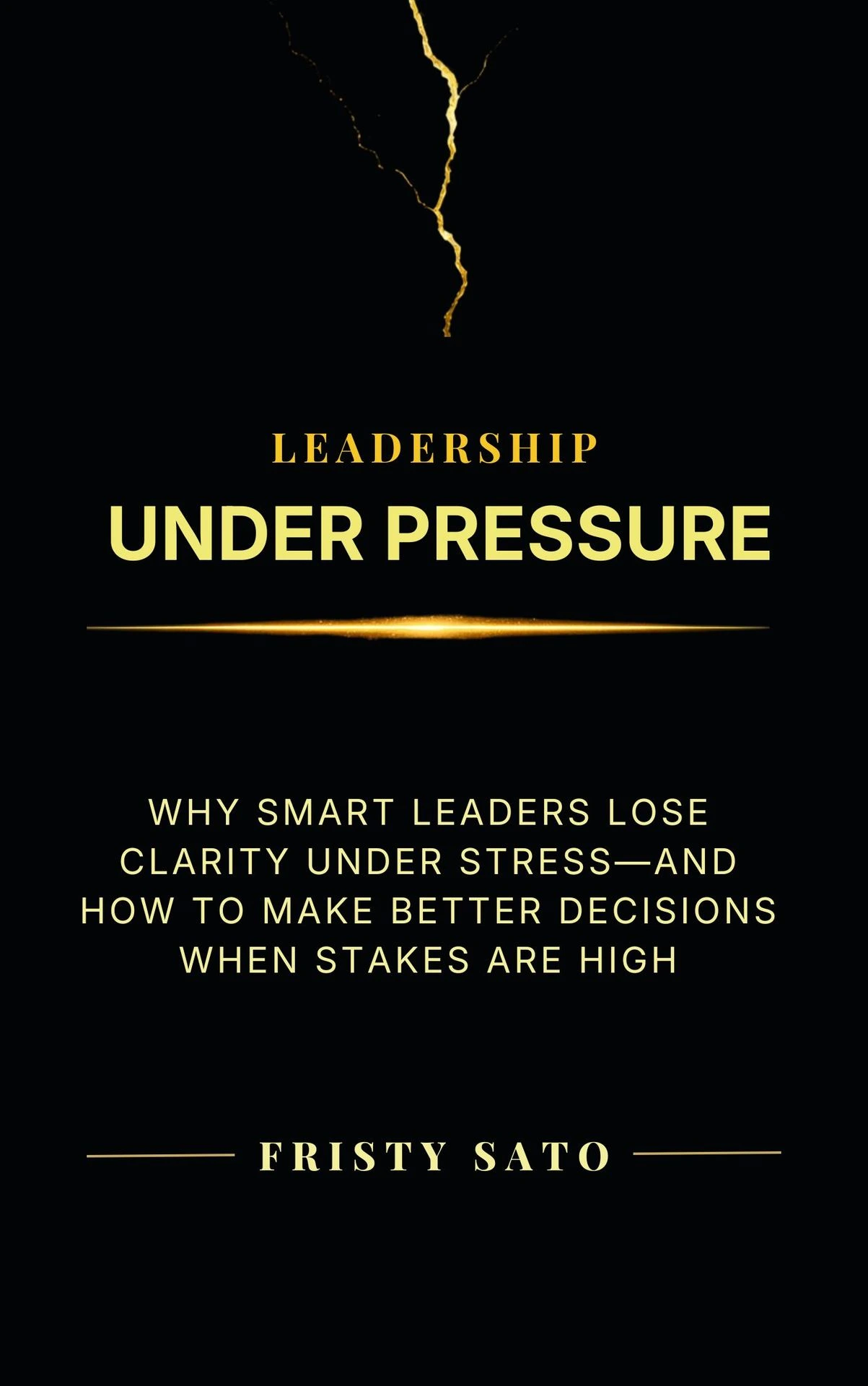
Read the Book: Leadership Under Pressure
Leadership becomes especially challenging when the stakes are high.
Decisions become more complicated, emotions become stronger, and the pressure to get things right can affect clarity.
In Leadership Under Pressure: Why Smart Leaders Lose Clarity Under Stress—and How to Stay Clear When Stakes Are High, Fristy Sato explores why capable leaders can struggle to maintain clarity under pressure and how they can develop a more conscious relationship with their leadership responses.
For Organizations: Beyond Psychological Safety Initiatives
Is your organization investing in psychological safety but still experiencing low ownership, leadership bottlenecks, silence, or fear of mistakes?
Perhaps it's time to examine more than communication practices.
Consider how leadership patterns, organizational expectations, decision-making structures, and emotional experiences interact.
Emotionally Safe Leadership™ offers a complementary perspective for organizations that want to develop more conscious leaders and healthier working environments.
The goal is not simply to encourage people to speak.
It is to build leadership and organizational conditions in which people can speak, contribute, take responsibility, and grow.
Conclusion: Leadership Begins Beyond What We Say
We have spent years helping leaders understand why psychological safety matters.
We teach them to invite feedback, encourage disagreement, welcome mistakes, and create space for people to speak.
These practices matter. They help teams learn, contribute, and work together more effectively.
But there is another question worth asking.
What happens inside a leader when someone actually disagrees?
What happens when an employee makes a mistake?
What happens when someone challenges their authority, questions their decision, or brings information they don't want to hear?
Because this is where leadership becomes more than a set of behaviors.
A leader may know that people need freedom to speak but still struggle to receive what they say.
They may encourage ownership but feel uncomfortable when they lose control.
They may promote trust but still find it difficult to depend on other people.
They may want their teams to become independent while unconsciously creating situations where everyone depends on them.
This is why we need to look beyond what leaders know about creating safety.
We also need to understand what happens within them when safety is challenged.
Psychological safety helps us understand what people need to contribute.
Emotionally Safe Leadership™ helps us examine the emotional patterns that shape how leaders create the conditions for that contribution.
Neither replaces the other.
Both offer valuable perspectives on the leadership experience.
And when we bring them together, we can begin to understand why some leadership challenges persist even when leaders know what they should be doing.
Because leadership transformation doesn't begin when people simply learn to say the right things.
It begins when leaders become aware of what happens inside them, take responsibility for how they respond, and develop the capacity to lead differently.
The question is no longer only whether your team feels safe enough to speak. It is whether you are developing the emotional capacity to receive what they have to say.
That is where a deeper conversation about leadership begins.
And that is the opportunity behind Emotionally Safe Leadership™.
Explore the broader philosophy: Emotionally Safe Leadership™.
Continue Exploring Emotionally Safe Leadership™
If this article articulated something you have been experiencing within your own career, you are not alone. The journey toward sustainable, high-impact authority begins by exploring the underlying systems that govern how we show up.
Featured Topics
What Is Emotional Safety?
Emotional Safety in Leadership
Emotional Safety at Work
Emotionally Safe Teams
Emotionally Safe Communication
Emotional Safety and Performance
Emotional Safety and Innovation
Emotional Safety and Trust
Psychological Safety vs Emotional Safety