We often assume pressure reveals how capable a leader is.
But pressure does something far more interesting.
It reveals how a leader has learned to survive responsibility.
When everything is calm, a leader may delegate well, listen carefully, communicate clearly, and trust her team.
Then the stakes rise. A major decision needs to be made. A key client is unhappy. Revenue becomes uncertain. A team member makes a serious mistake. The organization grows faster than expected.
Suddenly, the leader who usually trusts her team starts checking every detail. The leader who normally communicates calmly becomes sharp. The leader who usually makes decisions quickly starts overthinking. The leader who encourages people to take ownership starts taking everything back.
This isn’t a failure of leadership skill.
It’s a survival pattern becoming visible under pressure.
What Does Leadership Under Pressure Mean?
Leadership under pressure is the ability to continue making conscious, effective decisions while navigating conditions that increase uncertainty, responsibility, emotional intensity, or perceived risk.
Pressure comes from many sources:
Rapid organizational growth
Financial uncertainty or shifting budgets
Public visibility and high stakeholder expectations
Team conflict and difficult conversations
Resource constraints and competing priorities
Managing organizational change or crisis
True leadership under pressure isn't about becoming someone who never feels stress. It's about becoming less controlled by what pressure activates inside you.
When you learn to separate immediate emotional activation from your executive choice, pressure stops driving the business.
Why Leadership Beliefs Matter
Beliefs dictate interpretation. Interpretation drives behavior. And behavior creates the environment that everyone else has to work inside.
Consider this progression:
Internal Belief
"A good leader should always have the answer."
       │
       ▼
Interpretation
Uncertainty is interpreted as an operational failure.
       │
       ▼
Emotional Response
Internal pressure, chest tightness, and urgency.
       │
       ▼
Leadership Behavior
Over-preparing, delaying decisions, or faking certainty.
       │
       ▼
Team Experience
The team learns that uncertainty is unsafe.
       │
       ▼
Organizational Outcome
People stop bringing fresh ideas and wait for instructions.
The leader experiences stress. The team experiences culture.
When a leader operates from an unexamined belief, she isn't just managing work—she is unconsciously broadcasting a set of rules to her entire organization.
Why Pressure Changes Leadership
When stress rises, your mind naturally shifts its baseline operating system. Pressure fundamentally changes five core dynamics:
What you notice: Threats, risks, and potential mistakes become far more visible than long-term opportunities.
How you interpret events: A minor delay or a team member's question feels like evidence that everything is falling apart.
How quickly you respond: The urge to react replaces the capacity to reflect.
What you prioritize: Immediate emotional relief replaces strategic execution.
How you relate to others: Trust decreases, control tightens, and communication becomes sharp, flat, or distant.
       [ Pressure Rises ]
               │
               ▼
   [ Threat-Focused Attention ]
               │
               ▼
  [ Internal Emotional Activation ]
               │
               ▼
[ Urgency Replaces Strategic Choice ]
Stress doesn't just make you tired. It narrows your vision. It convinces you that short-term relief is the same thing as long-term leadership.
The Pressure-to-Behavior Cycle
Your internal response to stress never stays inside your body. It creates a domino effect that impacts your team's daily reality and the organization's bottom line.
$$\text{Pressure} \longrightarrow \text{Activation} \longrightarrow \text{Survival Pattern} \longrightarrow \text{Behavior} \longrightarrow \text{Team Experience} \longrightarrow \text{Outcome}$$
 PRESSURE
 Something important is at stake.
    │
    ▼
 EMOTIONAL ACTIVATION
 Fear, urgency, uncertainty, threat, or responsibility overload.
    │
    ▼
 SURVIVAL PATTERN
 Control, Prove, Over-function, Suppress, Withdraw, Avoid, Hyper-independence.
    │
    ▼
 LEADERSHIP BEHAVIOR
 Micromanagement, overworking, overthinking, emotional shutdown, taking over.
    │
    ▼
 TEAM EXPERIENCE
 Tension, silence, dependency, confusion, fear of mistakes, reduced initiative.
    │
    ▼
 ORGANIZATIONAL OUTCOME
 Slower decisions, operational bottlenecks, burnout culture, high turnover.
The leader experiences pressure. The team experiences the leadership response to that pressure.
Pressure Does Not Affect Every Leader in the Same Way
Every leader carries a learned strategy for creating safety under stress. When pressure rises, these strategies activate automatically:
The Responsible Leader™: Pressure says, "Everyone is depending on me." She responds by carrying more weight alone.
The Strong Leader™: Pressure says, "I cannot fall apart." She suppresses all emotion and performs unshakeable resilience.
The Capable Leader™: Pressure says, "I need to solve this." She jumps into operational firefighting.
The Self-Reliant Leader™: Pressure says, "I cannot depend on anyone else." She hoards information and isolates.
The Protective Leader™: Pressure says, "Something could go wrong." She tightens control and micromanages.
The Proving Leader™: Pressure says, "I must prove I belong here." She over-prepares, delays, and over-analyzes.
The Achievement-Driven Leader™: Pressure says, "I need to do more." She creates artificial emergencies and moves goalposts.
These aren't static personality types. They are adaptive survival responses. You might recognize yourself in several, with one or two taking over when the stakes are high.
Why Smart Leaders Lose Clarity Under Stress
Intelligence doesn't vanish under pressure. But your emotional system can easily block your intellectual capacity.
+-------------------------------------------------------------------+
|                     INTELLECTUAL CAPACITY                         |
|   (Strategy, Market Knowledge, Skill, Experience, Management)     |
+-------------------------------------------------------------------+
                                  │
                       [ Pressure & Threat ]
                                  │
                                  ▼
+-------------------------------------------------------------------+
|                      EMOTIONAL ACTIVATION                         |
|   (Fear of Exposure, Urgency, Over-Responsibility, Isolation)     |
+-------------------------------------------------------------------+
                                  │
                                  ▼
+-------------------------------------------------------------------+
|                        EXECUTIVE ACTION                           |
|       (Micromanagement, Overthinking, Bottlenecks, Hesitation)    |
+-------------------------------------------------------------------+
A smart leader still knows what to do intellectually. But when emotional activation takes over, accessing that clarity becomes difficult.
This loss of clarity happens through six subtle shifts:
Overthinking: You run endless scenarios trying to eliminate all risk. More analysis produces more anxiety, not more clarity.
Artificial Urgency: Everything feels like an emergency. Essential priorities get buried under immediate noise.
Threat-Focused Attention: You focus so heavily on what could go wrong that you lose sight of what could work.
Identity Protection: The decision stops being "What is best for the organization?" and becomes "If I get this wrong, what does it say about me?"
Responsibility Overload: You absorb every operational problem personally, leaving no room for strategic clarity.
Loss of Perspective: You mistake short-term emotional relief for long-term strategic execution.
Sticky Line: A high-stakes decision becomes exhausting when you are not only deciding what to do, but also trying to protect your identity while you decide.
The Difference Between Pressure and Panic
Pressure isn't automatically harmful. It can sharpen your focus, clarify priorities, and mobilize resources.
The goal isn't to eliminate pressure. The goal is to prevent pressure from turning into survival-based panic.
| Pressure | Panic |
| Focuses attention on what matters | Scatters attention across every threat |
| Mobilizes strategic action | Drives reactive, short-term fixes |
| Clarifies priorities | Makes every task feel like an emergency |
| Maintains team connection | Transmits fear and creates isolation |
| Operates from conscious choice | Operates from automatic survival |
When Pressure Becomes Survival-Based Leadership™
Survival-based leadership happens when your response to stress is organized around creating internal emotional safety, rather than responding to what the situation actually requires.
You might catch yourself thinking:
"If I control every detail, I will feel safer."
"If I solve this problem myself, I stay useful."
"If I never show doubt, people will trust me."
"If I don't depend on anyone, I can't be disappointed."
These responses reduce short-term discomfort for the leader. But they carry massive long-term costs for the organization.
Pressure Reveals Leadership Beliefs
Pressure acts as a stress-test for your unexamined assumptions about work:
"A good leader should always have the answer."
"If something fails, it is entirely my fault."
"Asking for help is a sign of incompetence."
"Mistakes are dangerous and unacceptable."
When stress hits, these beliefs dictate your actions.
Unexamined Belief ──> Pressure Activation ──> Threat Interpretation ──> Reactive Behavior
If you believe a good leader must handle everything alone, rising pressure won't make you delegate. It will make you work until you collapse.
Pressure Reveals Leadership Identity
Under normal conditions, your leadership identity looks like a set of strengths:
Reliable
Hyper-capable
Supportive
Thorough
Under pressure, those same strengths can harden into rigid survival adaptations:
[ Reliable ]        ──> (Pressure Rises) ──>  [ Cannot Delegate / Over-functions ]
[ Hyper-Capable ]   ──> (Pressure Rises) ──>  [ Takes Tasks Back / Firefights ]
[ Supportive ]      ──> (Pressure Rises) ──>  [ Rescues Others / Absorbs Consequences ]
[ Thorough ]        ──> (Pressure Rises) ──>  [ Analysis Paralysis / Delays Decisions ]
Pressure doesn't just reveal what you believe. It reveals who you think you have to be to remain safe and valuable.
How Pressure Affects Decision-Making
When stakes rise, decision-making often breaks down in predictable ways:
Decision Avoidance: Delaying sign-offs under the guise of needing "more data."
Excessive Checking: Re-auditing completed work, turning yourself into an operational bottleneck.
Impulsive Fixes: Making fast, erratic strategic pivots to soothe internal anxiety.
Seeking Reassurance: Polishing slide decks and over-preparing arguments to avoid criticism.
Clarity doesn't require certainty. A clear leader can make a decision while acknowledging, "I don't know exactly how this will unfold, but this is the best path forward with what we know today."
How Pressure Changes Communication
Under pressure, communication shifts away from connection and toward protection:
Communicating less: Retreating into isolation to figure things out alone.
Over-communicating: Flooding Slack channels with detailed instructions out of fear.
Becoming sharp or flat: Suppressing emotion to look composed, which comes across as distant or cold.
Making everything urgent: Using high-intensity language that exhausts the team.
The question isn't whether pressure changes your communication. It will.
The question is whether you notice the shift before your team absorbs the impact.
How Pressure Changes Delegation and Trust
Under stress, "It's just faster if I do it myself" feels logical.
Control offers immediate short-term rewards: speed, predictability, and a temporary drop in anxiety. But the long-term costs are heavy:
                  [ Leader Retakes Task ]
                             │
            ┌────────────────┴────────────────┐
            ▼                                 ▼
   [ Short-Term Reward ]             [ Long-Term Cost ]
   • Immediate control               • Team dependency
   • Temporary relief                • Leader burnout
   • Predictable outcome             • Operational bottleneck
Pressure makes control feel efficient. But what feels efficient to the leader becomes expensive for the organization.
How Teams Experience a Leader Under Pressure
Your team doesn't experience your internal stress directly. They experience the leadership behaviors your stress produces.
When you become controlling, your team learns: "Don't make decisions without approval."
When you become emotionally unavailable, your team learns: "Now is not a good time to bring up problems."
When you become reactive, your team learns: "Be careful how you deliver bad news."
When you over-function, your team learns: "If we wait long enough, she will fix it."
  LEADER'S INTERNAL STATE                 TEAM'S OPERATIONAL LESSON
┌─────────────────────────┐             ┌─────────────────────────┐
│  "I must control this"  │   ───────►  │  "Wait for permission"  │
├─────────────────────────┤             ├─────────────────────────┤
│  "I can't show weakness"│   ───────►  │   "Hide operational gaps"│
├─────────────────────────┤             ├─────────────────────────┤
│  "I must carry this"    │   ───────►  │   "Let the leader do it"│
└─────────────────────────┘             └─────────────────────────┘
Your team does not experience your internal pressure directly. They experience the leadership behavior your pressure produces.
Why Pressure Can Spread Through a Team
Stress is contagious. A leader’s tone, availability, urgency, and tolerance for errors set the emotional climate of the organization.
You don't have to say "panic" for a team to feel that things are unsafe. Your behavior communicates it for you.
When a leader regulates her own nervous system under stress, she creates an anchor for the entire team. Safety isn't created by making promises. It's created by remaining grounded when the stakes are high.
Emotional Safety Under Pressure
Emotional safety under pressure does not mean:
Removing accountability
Lowering standards
Avoiding difficult conversations
Making everyone comfortable at all times
Emotional safety is the internal capacity to remain grounded, conscious, and connected while navigating pressure, uncertainty, and responsibility.
Emotionally Safe Leadership™ doesn't remove pressure from leadership. It changes your relationship with it.
Staying Clear Under Pressure Does Not Mean Staying Calm
Calm is often mistaken for clarity. But calmness can sometimes be an emotional mask—a way of suppressing internal stress to look composed.
A clear leader can feel concerned, focused, serious, or urgent without losing her decision-making capacity.
                       EMOTIONAL STATE
                              │
               ┌──────────────┴──────────────┐
               ▼                             ▼
       [ Emotional Flatness ]       [ Emotional Choice ]
       Suppression & Masking        Grounding & Awareness
               │                             │
               ▼                             ▼
      (False Composure)             (Clear Leadership)
The goal isn't emotional flatness. The goal is emotional choice.
What Clear Leadership Under Pressure Looks Like
A leader operating with clarity under pressure can:
Separate facts from emotional interpretations
Acknowledge uncertainty without panicking
Make decisions without demanding 100% predictability
Communicate clearly about what is known and unknown
Maintain standards without creating a culture of fear
Allow others to solve problems without taking over
Stay connected to long-term goals during short-term fires
This is leadership capacity in action.
A Simple Pressure Check for Leaders
When the stakes rise and you feel yourself bracing, pause and run this simple check:
1. What is actually happening?
   (Separate facts from assumptions)
         │
2. What am I feeling in my body?
   (Locate tension, urgency, or fear)
         │
3. What am I afraid will happen if I don't step in?
   (Identify the perceived threat)
         │
4. What am I trying to control right now?
   (Spot the survival response)
         │
5. What responsibility am I carrying that belongs to someone else?
   (Locate over-functioning)
         │
6. What does my team need from me right now?
   (Shift focus back to leadership)
         │
7. What would clarity look like if I didn't need certainty?
   (Access conscious choice)
Leadership Under Pressure and the Seven Survival Patterns
| Survival Pattern | Under Pressure, Survival Response Looks Like |
| The Responsible Leader™ | "I need to carry this whole load myself." |
| The Strong Leader™ | "I cannot let anyone see that this is affecting me." |
| The Capable Leader™ | "I need to jump in and solve this operational fire personally." |
| The Self-Reliant Leader™ | "I need to isolate and handle this without help." |
| The Protective Leader™ | "I need to micromanage every detail to prevent chaos." |
| The Proving Leader™ | "I need more data before I can justify this decision." |
| The Achievement-Driven Leader™ | "I need to create urgency and push harder." |
These responses happen automatically before you have time to reflect. Recognizing them is the first step toward changing them.
Leadership Under Pressure During Change, Conflict, and Growth
Pressure shows up differently depending on the context:
During Rapid Growth
Pressure comes from increased complexity, decision volume, and visibility. The urge to control or over-function spikes as the organization outgrows old systems.
During Organizational Change
Pressure comes from ambiguity and a lack of control. Leaders often delay decisions, searching for certainty that doesn't exist.
During Conflict
Pressure comes from emotional discomfort and the fear of relational damage. Leaders either avoid the conversation or become overly direct and sharp.
During Sustained Overload
Pressure becomes chronic. The body stays in a constant state of high alert, making decision fatigue and burnout almost inevitable.
Pressure, Leadership Stress, and Burnout: What's the Difference?
These terms are often used interchangeably, but they represent distinct experiences:
Leadership Pressure: The external demands, stakes, uncertainty, and responsibilities of the role.
Leadership Stress: The immediate emotional and somatic response to those demands.
Leadership Burnout: The chronic physical, mental, and emotional exhaustion that occurs when pressure is navigated through survival strategies over long periods without recovery.
Pressure (External Demand)
   └──> Survival Pattern (Internal Response)
           └──> Chronic Stress (Somatic Activation)
                   └──> Burnout (System Exhaustion)
Pressure doesn't automatically cause burnout. How you repeatedly respond to pressure determines whether it leads to growth or exhaustion.
What Emotionally Safe Leadership™ Changes
Emotionally Safe Leadership™ shifts your default response to pressure:
Pressure → Awareness → Regulation → Conscious Choice → Leadership Action
The goal isn't to never feel activated. The goal is to notice activation sooner, ground yourself faster, and choose your response consciously.
This is the core of the Regulate phase in the SAFE Expansion™ Pathway: recognize the activation, settle your nervous system, and lead from clarity instead of survival.
Leadership Under Pressure Is a Capacity, Not a Personality Trait
Some leaders appear naturally calm. But composure isn't always capacity—sometimes it's just emotional suppression.
Others may feel deep concern under stress, yet remain exceptionally clear in their choices.
The goal isn't to project a calm image. The goal is to build the internal capacity to stay connected to reality while your emotional system navigates pressure.
Reflection: What Does Pressure Bring Out of You?
Take a moment to reflect on your default responses when the stakes rise:
What happens to my body when pressure increases?
Do I default to controlling, proving, over-functioning, or isolating?
Do I make decisions more slowly, or do I act impulsively out of urgency?
How does my tone and communication change when I feel stressed?
What does my team experience when I am under pressure?
What am I afraid would happen if I dropped my protective armor?
What would clear leadership look like in this situation if I didn't need certainty?
The Bigger Question
The goal of leadership isn't to eliminate pressure. High-stakes moments, uncertainty, conflict, and difficult choices will always be part of leading people.
The question isn't whether pressure will come.
The question is what pressure will bring out of you.
Leadership under pressure isn't just about what you do when things get hard. It's about whether you can stay clear enough to choose how you lead when your emotional system wants to protect itself.
The strongest leader in the room isn't the one who feels the least pressure. It's the one who can feel the pressure without letting it decide how everyone else experiences the room.
Go Deeper: Read the Book
Leadership Under Pressure
Why Smart Leaders Lose Clarity Under Stress—and How to Stay Clear When Stakes Are High
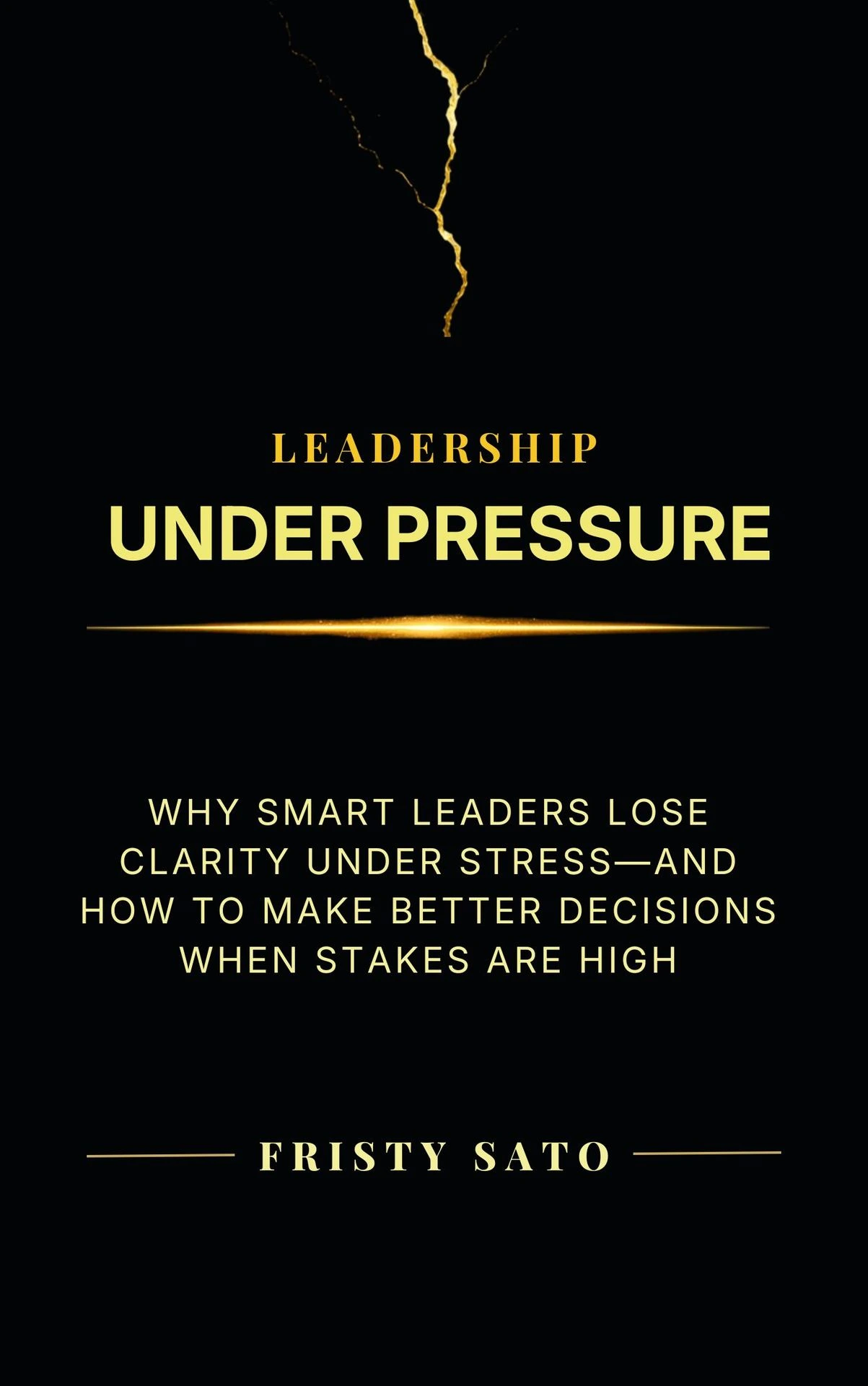
Pressure doesn't simply test your leadership skills. It reveals the patterns underneath them.
In Leadership Under Pressure, Fristy Sato explores why capable leaders lose clarity, overthink decisions, become controlling, withdraw, or struggle to lead effectively when the stakes rise.
If you want to understand what happens to your leadership under pressure—and learn how to stay clear when it matters most—this book is your next step.
Discover Your Leadership Pattern
Not sure what pressure brings out in your leadership? Take the free Emotionally Safe Leadership Assessment™ to identify the survival pattern that takes over when the stakes rise.
Continue Exploring Emotionally Safe Leadership™
If this article articulated something you have been experiencing within your own career, you are not alone. The journey toward sustainable, high-impact authority begins by exploring the underlying systems that govern how we show up.
Featured Topics
Leadership Identity™
Leadership Beliefs
Leadership Under Pressure
Nervous System and Leadership
Emotional Regulation for Leaders
Decision-Making Under Pressure
Trauma-Informed Leadership