A team may hit every target, work long hours, respond instantly to messages, look highly committed, feature impressive individual performers, and rarely complain—and still not be genuinely high-performing.
Ask yourself quietly:
Can the team make good decisions without you in the room?
Can people disagree without becoming defensive?
Can someone admit a mistake early before it becomes a crisis?
Can people take time off without everything falling apart?
Can performance remain strong when pressure increases?
If the answer to those questions is complicated, we need to look closer at an uncomfortable truth.
High output is not the same as high performance.
What Is a High-Performing Team?
Let’s define it clearly. A high-performing team is a group of people who consistently work toward shared outcomes with clarity, trust, accountability, effective communication, appropriate autonomy, healthy conflict, and the capacity to adapt under changing conditions.
Notice that true performance is made of two distinct parts:
1. Results
Quality and productivity
Goals and delivery
Customer and business outcomes
2. Capacity
Trust and learning
Decision-making and collaboration
Resilience and ownership
Adaptability and sustainable workload
Leadership capacity
Results tell you what the team produced. Team capacity tells you whether the team can keep producing it.
When organizations ignore capacity, they mistake temporary endurance for permanent capability.
High Performance Is Not the Same as High Pressure
Accountability is the willingness and ability to answer for commitments, decisions, actions, and outcomes.
Healthy accountability includes:
Explicit expectations and clear boundaries
Defined decision rights
Honest, transparent communication
Acknowledging mistakes early and correcting them together
Continuous learning from real-world results
Appropriate consequences when agreements are repeatedly broken
What Accountability Is NOT
Organizations often confuse pressure with performance because pressure works—for a little while.
Pressure can temporarily produce urgency, longer hours, rapid execution, intense focus, and compliance. But chronic pressure also produces burnout, fear, information hiding, reduced creativity, poor judgment, dependency, disengagement, turnover, and emotional exhaustion.
Pressure can increase effort without increasing capacity.
When a team only runs on pressure, it operates from survival. And when survival becomes the baseline, performance becomes fragile.
High-Performing Teams vs. High-Pressure Teams
| High-Performing Team | High-Pressure Team |
| Clear priorities | Constant urgency |
| High standards | Fear of failure |
| Ownership | Permission-seeking |
| Trust | Monitoring |
| Healthy challenge | Defensive conflict |
| Early problem-sharing | Hidden problems |
| Distributed decisions | Leader dependency |
| Sustainable workload | Chronic overwork |
| Learning from mistakes | Blame |
| Strong results | Short-term output |
| Adaptability | Reactivity |
| Shared capacity | Hero dependence |
Note: High-performing teams still experience pressure. The difference is how the team functions when that pressure arrives.
The Core Characteristics of Sustainable High-Performance
Building a high-performing team isn't about demanding more effort. It is about establishing the conditions where excellence happens naturally:
Clear shared purpose: People understand what matters, why it matters, and what does not matter right now.
Clear roles and decision rights: People know who owns what, who decides, and when to escalate.
Trust: People can rely on one another without second-guessing motives (explore more through our cornerstone on Team Trust).
Psychological safety: People can speak honestly, ask questions, disagree, and admit mistakes early (explore more through our cornerstone on Psychological Safety).
Healthy accountability: People follow through without needing fear or constant supervision (explore more through our cornerstone on Ownership and Accountability).
Genuine ownership: People think beyond assigned tasks. They notice problems and contribute to outcomes.
Healthy conflict: High-performing teams do not avoid disagreement; they know how to disagree without it becoming personal.
Strong communication: Information moves early enough for people to make sound decisions.
Adaptability: The team can change direction seamlessly when reality shifts.
Sustainable capacity: The team performs without relying on chronic overwork or emotional sacrifice.
The Emotional System of a Team
Every team has an emotional system, whether leadership talks about it or not.
Every day, people are quietly asking themselves unspoken questions:
Is it safe to disagree here?
What happens when I make a mistake?
Who gets blamed?
Can I actually ask for help?
Does the leader trust us?
These repeated experiences form team behavior. They connect directly back to the principles of Emotionally Safe Leadership™. When a leader operates from an unconscious survival pattern—like over-functioning or control—it shapes the team's emotional experience, creating norms of passivity or dependency.
The Two Loops
The Healthy High-Performance Loop
Clarity → Trust → Psychological Safety → Ownership → Healthy Accountability → Learning → Better Decisions → Strong Results → Greater Trust
When people experience trust and clarity, they take more ownership. When ownership increases, leaders don't need to control as much. When control decreases, autonomy grows. Autonomy strengthens capability, and performance creates confidence.
The Survival-Based Performance Loop
Pressure → Fear → Over-control → Compliance → Dependency → Leader Over-functioning → Team Passivity → Burnout → Lower Capacity → More Pressure
Some teams do not have a performance problem. They have a survival system that happens to produce results.
What High-Performing Teams Do Differently
High-performing teams do not avoid friction; they handle it differently. They:
Surface problems early before they become crises.
Discuss difficult issues directly without defensive posturing.
Ask for help when capacity is reached.
Challenge assumptions safely to improve decision quality.
Make decisions at the appropriate operational level rather than escalating everything to the top.
Take personal responsibility for shared outcomes.
Learn actively from mistakes without assigning blame.
Share information transparently.
Adapt quickly when market conditions shift.
Protect important priorities from background noise.
Support each other without slipping into rescuing.
Hold high standards without using humiliation.
Know when to slow down to think clearly and when urgency is genuinely required.
High-Performing Teams and Psychological Safety
Psychological safety does not create performance by itself. But without enough psychological safety, teams lose access to vital information.
People hide mistakes, avoid challenging leaders, stay silent when risks appear, soften bad news, avoid asking questions, and protect their reputations. That destroys decision quality.
A team cannot consistently make good decisions if people do not feel safe enough to share what they actually see.
Psychological safety is not comfort, agreement, low standards, or avoiding consequences. High-performing teams are simultaneously psychologically safe and highly accountable.
High-Performing Teams and Trust
Trust allows delegation, information sharing, healthy disagreement, mutual reliance, vulnerability, and distributed decisions.
However, trust does not mean assuming everyone will always perform well. Healthy trust includes clear accountability. High trust combined with high accountability creates genuine ownership.
High-Performing Teams and Ownership
A team cannot become genuinely high-performing if every meaningful decision returns to the leader. Ownership requires clarity, authority, trust, competence, information, and room to act.
If the leader is the only person who can solve important problems, the organization does not have a high-performing team. It has a high-performing leader carrying a team.
The Leader's Role in a High-Performing Team
The leader's job is not to drive everything or become the answer to every problem. The modern leader's role is to:
Create clarity and establish standards.
Build trust and distribute authority.
Develop team capability and protect healthy boundaries.
Make difficult decisions while creating conditions for honest information.
Address unhealthy patterns and prevent dependency.
The more capable the team becomes, the less the leader needs to be the center of every decision.
Emotional Patterns That Can Undermine Team Performance
Unconscious survival patterns at the leadership level directly distort team performance:
Strong Leader ("I need to be strong enough to handle everything."): Can create over-control, low vulnerability, and severe leader dependency.
Capable Leader ("I can do this faster myself."): Can create poor delegation, operational bottlenecks, and underdeveloped team capability.
Responsible Leader ("If something goes wrong, it is my job to fix it."): Can create over-functioning, rescuing, and blurred accountability.
Self-Reliant Leader ("Depending on others is risky."): Can create weak collaboration, low interdependence, and unnecessary individual workload.
Proving Leader ("I need to show that I can deliver."): Can create hero culture, internal competition, and chronic overwork.
Achievement-Driven Leader ("We need results no matter what."): Can create chronic pressure and performance at the expense of long-term capacity.
Protective Leader ("I need to prevent problems."): Can create excessive control, reduced experimentation, and low autonomy.
These patterns are not character flaws; they are adaptive strategies. But when repeated at the leadership level, they become expensive.
The Personal → Leadership → Team → Organizational Lens
Team performance is never just a "team problem." It flows through a clear systemic pipeline:
Personal: Leader feels pressure, fear, responsibility, uncertainty, and a need for control or proof.
Leadership: Leader takes over, controls, avoids conflict, overworks, and reacts strongly to mistakes.
Team: Team waits, hides problems, depends on the leader, over-functions, avoids challenge, and stops taking initiative.
Organization: Organization experiences bottlenecks, burnout, poor succession planning, low innovation, slow decisions, high turnover, and fragile performance.
High Performance and Healthy Conflict
High-performing teams are not harmonious echo chambers. They regularly disagree about priorities, strategy, resources, decisions, execution, and risk.
The difference is that disagreement does not turn into personal attacks, defensiveness, silence, political maneuvering, or avoidance.
A team that never disagrees may not be highly aligned. It may simply be highly cautious.
High-Performing Teams and Employee Engagement
Engagement grows when people experience meaningful work, contribution, influence, connection, trust, recognition, growth, and sustainable capacity.
We must not confuse high engagement with high availability. Someone answering messages at midnight is not automatically more engaged than someone who maintains healthy boundaries. Engagement should increase contribution, not require self-abandonment.
High Performance and Burnout
A dangerous organizational pattern occurs when high performance leads to recognition, which leads to more workload and responsibility, followed by less recovery, leading straight to burnout and performance decline.
In many teams, burnout is hidden because everyone is committed, high performers compensate for broken systems, people avoid complaining, and overwork is culturally rewarded.
A team can be performing well and becoming less capable at the same time.
The High-Performer Trap
Organizations often depend dangerously on a few individuals—the same people always solve problems, take on difficult work, stay late, and become informal bottlenecks. When people are promoted solely because they can carry more weight, it creates dependency, resentment, burnout, succession risk, and concentrated knowledge failure.
Are you building a high-performing team, or simply extracting more capacity from your highest-capacity people?
High-Performing Teams Under Pressure
Pressure reveals team architecture. Under acute stress:
Healthy teams communicate, prioritize, delegate, escalate early, make decisions, support one another, and stay connected to reality.
Survival teams experience leader takeover, narrowing information flow, rising blame, defensiveness, centralized decisions, ballooning workloads, and hidden mistakes.
Pressure does not always create dysfunction. It often reveals the dysfunction that was already there. (Explore more in Leadership Under Pressure).
How to Build a High-Performing Team
Sustainable high performance is built as a complete system:
Define the outcome: What does the team actually exist to accomplish?
Create role clarity: Who owns what?
Clarify decision rights: Who has the authority to decide?
Build trust: Can people genuinely rely on each other?
Create psychological safety: Can people tell the truth without fear?
Establish healthy accountability: Are standards clear and upheld?
Develop ownership: Does authority match responsibility?
Normalize healthy conflict: Can people challenge assumptions safely?
Reduce dependency: What does the leader need to stop carrying?
Protect sustainable capacity: Can the team perform without chronic self-sacrifice?
Learn continuously: Does the team examine how it works, not only what it produces?
Adapt: Can the team change when conditions change?
How to Diagnose a Team's Performance
Instead of asking only, "Are we hitting our targets?" audit your team across five dimensions:
Results: Are we delivering? Is quality strong? Are stakeholders getting what they need?
Team Capacity: Can people make decisions? Can they challenge assumptions? Can the team function without the leader?
Relationships: Do people trust each other? Can they disagree openly? Do they communicate early?
Ownership: Do people act without waiting for permission? Is responsibility distributed?
Sustainability: Are people exhausted? Is performance dependent on overtime? Are high performers overloaded?
High-Performing Teams Are Not Perfect Teams
High-performing teams still make mistakes, disagree, have difficult conversations, experience pressure, miss targets sometimes, and feel interpersonal tension.
The difference is how they respond. A high-performing team can say, "Something isn't working," without turning that statement into, "Someone must be failing."
Performance is not the absence of problems. It is the team's capacity to respond to problems well.
Why Team-Building Activities Often Do Not Fix Performance
Traditional team-building exercises cannot compensate for poor leadership, unclear roles, excessive workload, low trust, unsafe communication, unclear authority, broken systems, or chronic pressure.
A team does not become high-performing because people had a better workshop together. It becomes high-performing when the way they work together fundamentally changes.
Why High-Performance Initiatives Fail
Common organizational missteps include focusing only on metrics, adding more training, creating more meetings, rewarding heroic effort, confusing speed with effectiveness, ignoring emotional dynamics, asking employees to be more resilient, increasing accountability without authority, demanding ownership while micromanaging, and measuring output while ignoring sustainability.
You cannot create sustainable high performance by continuously extracting more effort from the same people.
From High-Performing Teams to Emotionally Safe Organizations™
A high-performing team is not isolated from its organization. Team behavior is shaped by leadership, organizational systems, incentives, workload, culture, decision structures, and psychological safety.
Emotionally Safe Leadership™ examines the emotional patterns beneath leadership behavior. The Emotionally Safe Organization™ expands that lens to the overarching systems that shape how people experience work. High-performing teams become one natural expression of that larger organizational system.
The Five Conditions for Sustainable High Performance
Sustainable high performance rests on five foundational pillars:
Clarity + Safety + Ownership + Accountability + Capacity = Sustainable High Performance
Clarity: People know what matters.
Safety: People can tell the truth.
Ownership: People have enough authority to influence outcomes.
Accountability: People follow through and address reality.
Capacity: People can sustain performance without chronic self-sacrifice.
Final Reflection
The goal is never to create a team that can work harder.
It is to create a team that can think, decide, communicate, adapt, and perform well without requiring people to live in survival mode.
A truly high-performing team does not need a leader who carries everything. It has enough clarity, trust, ownership, accountability, and capacity for leadership to become distributed.
The strongest teams are not the ones that demand the most from their people. They are the ones that create the conditions for people to contribute at their highest sustainable capacity.
Discover the Emotional Patterns Shaping Your Leadership
If you are looking to audit your own leadership patterns that may be influencing your team's dynamics, take our Free Emotionally Safe Leadership Assessment™.
Take a Free Leadership Course
To transform your team’s operating system from the root up, explore our course: The Hidden Emotional Patterns Shaping Your Leadership™.
Take The Hidden Emotional Patterns Shaping Your Leadership™ Free Course on Udemy
Explore The Book
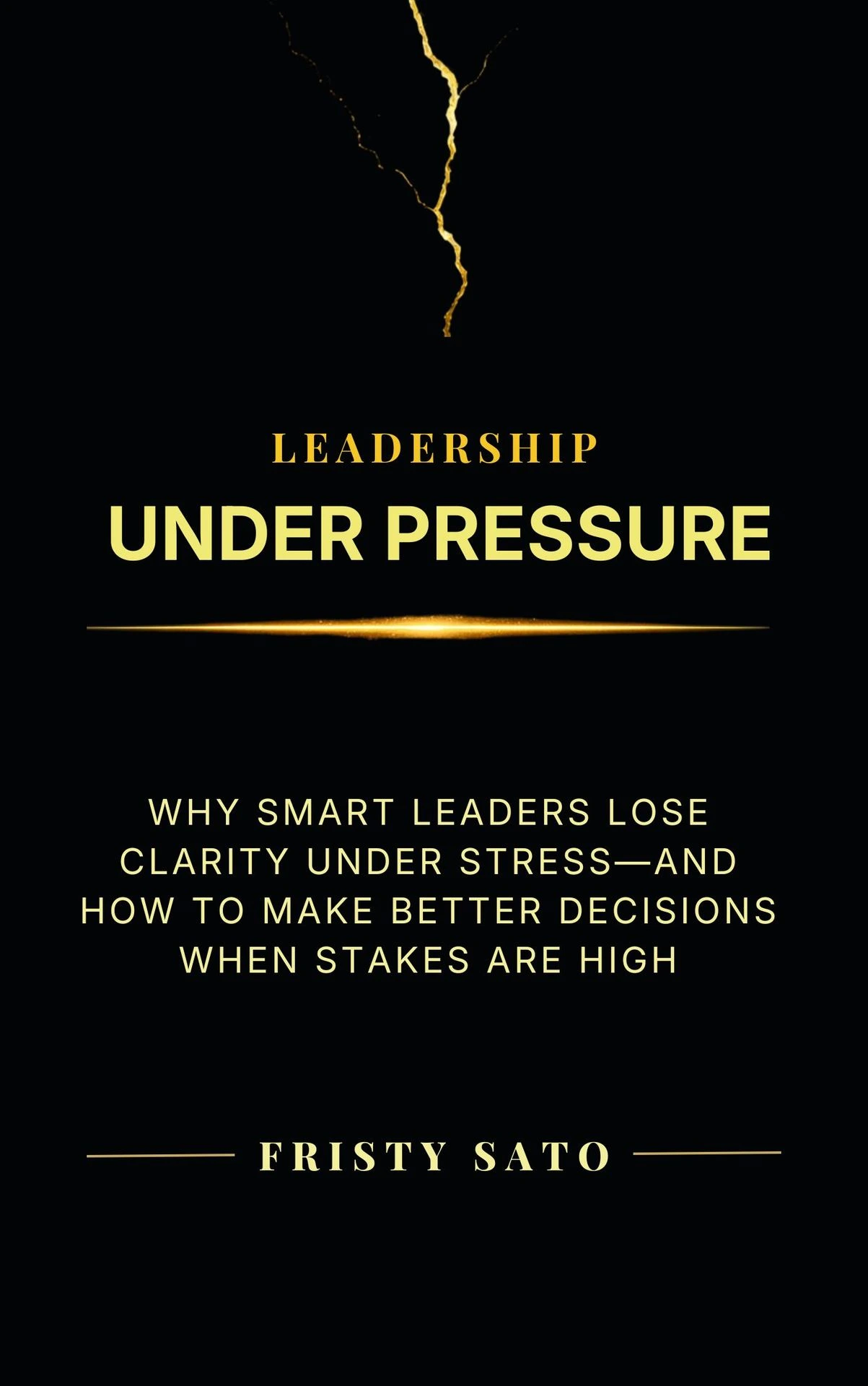
For a deeper dive into the leadership mindset required under stress, explore the book Leadership Under Pressure: Why Smart Leaders Lose Clarity Under Stress—and How to Stay Clear When Stakes Are High by Fristy Sato.
Ready to dismantle the hidden operational bottlenecks in your organization?
Book a private, 90-minute Leadership Pattern Breakthrough™ Session with Fristy Sato to map your nervous system patterns directly against your current org chart and team performance.
Continue Exploring Emotionally Safe Leadership™
If this article articulated something you have been experiencing within your own career, you are not alone. The journey toward sustainable, high-impact authority begins by exploring the underlying systems that govern how we show up.
Featured Topics
Healthy Workplace Culture
Team Trust
Psychological Safety
Employee Engagement
Ownership and Accountability
High-Performing Teams
Innovation and Creativity
Leading Organizational Change
Organizational Resilience