You can be highly competent and still struggle to be seen as a leader.
You can know more than anyone else in the room and still hesitate when it is time to speak up. You can have brilliant, strategic ideas, but find yourself over-explaining them out of a subtle fear that people won’t understand. You can be deeply confident in your daily work, yet become uncertain and guarded when senior leaders enter the room. You can lead a large team with skill and still feel like you constantly need to prove that you belong at the executive table.
This is where executive presence becomes essential.
Yet, executive presence is often misunderstood. It is not simply about looking powerful, speaking with forced gravity, or knowing how to command a room through sheer force of personality.
At its core, executive presence is the ability to communicate with credibility, clarity, confidence, judgment, and appropriate authority in situations where leadership influence matters.
The strongest executive presence is never performed. It is supported by internal clarity, self-trust, emotional regulation, sound judgment, and a healthy, grounded relationship with authority.
What Is Executive Presence?
Conventionally, executive presence refers to the constellation of observable signals that influence whether others perceive a leader as:
Credible and knowledgeable
Confident and poised
Capable and strategic
Composed under pressure
Influential and trustworthy
Authoritative and ready for greater responsibility
Executive presence is not a single, isolated behavior. It is an overall impression created across multiple touchpoints—including communication style, decision-making velocity, strategic framing, body language, composure, listening depth, and the ability to navigate high-stakes moments.
Important Distinction: Executive presence is partly about how you are perceived by others, but it should never become a project of obsessively managing other people's perceptions. When impression management becomes your primary goal, authentic leadership disappears.
Executive Presence vs. Leadership Presence
While these terms are frequently used interchangeably, they serve distinct operational purposes across your leadership journey:
Leadership Presence asks: What do people experience when they are being led by you? It applies across everyday team dynamics, interpersonal relationships, conflict resolution, daily communication, trust-building, and psychological safety.
Executive Presence asks: How do you carry authority, credibility, judgment, and influence in high-stakes professional environments? It becomes acutely vital in boardroom meetings, executive steering committees, senior stakeholder negotiations, strategic pivot decisions, high-visibility presentations, and succession evaluations.
Executive presence is one specific, high-stakes expression of leadership presence.
Executive Presence Is Not Charisma
Charisma can certainly help capture attention, but true executive presence does not require you to be extroverted, highly expressive, entertaining, socially dominant, or naturally magnetic.
A quiet, understated executive can command profound presence through crisp clarity and flawless judgment. Conversely, a highly charismatic leader can display disastrous executive judgment.
Executive presence is not about having the biggest personality in the room. It is about having enough clarity, credibility, and authority that your leadership can be felt and trusted without requiring a constant theatrical performance.
Executive Presence Is Not Confidence Alone
A leader may possess raw confidence without having good strategic judgment, deep listening skills, accountability, or emotional steadiness. Likewise, a highly capable, self-aware leader can experience moments of natural self-doubt while still demonstrating exceptional executive presence.
Confidence can certainly support executive presence, but it does not create it on its own.
Grounded confidence is not the rigid stance of "I know I am right." It is the quiet self-trust of "I trust myself enough to think clearly, listen deeply, make a decision, and adjust when new evidence appears."
The Visible and Invisible Layers of Executive Presence
Every interaction involving executive presence is shaped by two distinct layers:
The Visible Layer (What People Observe)
Communication pacing, tone, and linguistic clarity
Physical posture, composure, and eye contact
Decision-making speed and strategic framing
Active listening and responsiveness to challenge
Behavior during high-visibility meetings and presentations
The Invisible Layer (What Drives the Behavior)
Internal self-trust and self-worth
Unconscious emotional patterns and survival strategies
Fear of negative judgment or public exposure
The internal relationship with authority and hierarchy
Perfectionism and the desperate need to prove competence
The nervous system’s automated response to high-visibility pressure
Executive presence becomes extraordinarily difficult to cultivate when leadership development programs focus exclusively on training the visible layer while ignoring the internal engine driving it.
The Executive Presence Paradox
Here lies a signature truth of senior leadership: The harder you try to look like an executive, the more you move away from actually being present.
Why? Because your cognitive attention shifts away from the reality of the room and toward self-monitoring:
Monitoring the pitch of your voice instead of listening to the opposing argument.
Trying to sound "strategic" instead of genuinely thinking through the problem.
Trying to appear bulletproof instead of asking a vital clarifying question.
Avoiding uncertainty because looking competent matters more than finding the truth.
Speaking past your point simply because silence feels psychologically risky.
Executive presence weakens the moment impression management becomes more important than effective leadership.
The Core Dimensions of Executive Presence
Robust executive presence rests upon eight integrated dimensions:
Credibility: Do people trust your foundational competence and domain knowledge? (Built through consistency, integrity, and follow-through).
Clarity: Can you articulate what matters most without getting lost in unnecessary complexity?
Confidence: Can you express an informed point of view without needing everyone in the room to instantly agree with you?
Strategic Thinking: Can you look past immediate operational tasks to discern broader patterns, trade-offs, consequences, and long-term trajectory?
Judgment: Can you make sound, timely decisions despite incomplete information and ambiguity?
Composure: Can you remain functional, clear-headed, and responsive when the stakes rise? (Not emotionless, but functionally grounded).
Influence: Can you move people toward mutual understanding, alignment, and action without relying solely on positional authority?
Relational Awareness: Can you intuitively understand how your communication style and behavior affect the emotional climate of the room?
Executive Communication
Mastering executive communication requires discarding filler language and embracing purposeful brevity:
Lead with the point: State your recommendation, thesis, or decision early. Do not make senior leaders dig through twenty minutes of context to find out what you want.
Speak with appropriate confidence: Eliminate excessive qualifiers ("I just think maybe...", "This might be totally wrong..."), unnecessary apologies, and over-explaining. However, do not eliminate authentic nuance; when uncertainty is real, naming it accurately is a sign of high-level judgment.
Make your thinking visible: Senior stakeholders need to understand what you see, what trade-offs you weighed, what risks concern you, and why you recommend a specific path.
Know when to stop talking: True presence includes the discipline to deliver your point and let silence do the heavy lifting. You do not need to fill every pause to prove you belong in the room.
Executive Presence in Meetings
Practical execution during high-stakes gatherings requires discipline across three operational phases:
Before: Know precisely what decision or outcome is required. Understand your key stakeholders and their competing priorities. Identify your core point of view, prepare essential evidence, and carefully weigh trade-offs.
During: Contribute early when appropriate to establish your footing. Make your primary point with clean clarity. Listen deeply rather than waiting for your turn to speak. Ask incisive, useful questions. Disagree respectfully without becoming defensive. Avoid competing for airtime. Connect operational details directly to broader business impact, and summarize progress when discussions become fragmented.
After: Follow through swiftly on commitments. Clarify final decisions in writing. Communicate clear ownership so nothing falls into ambiguity.
The Deeper Layer: A single high-stakes meeting often reveals far more about a leader's underlying emotional patterns than their official job title ever could.
Executive Presence Under Pressure
When pressure spikes, standard behavioral patterns frequently morph into defensive habits. Under acute stress, some leaders become controlling, talk at double speed, over-explain their rationale, grow defensive, withdraw from engagement, avoid tough decisions, feign absolute certainty, or micromanage every detail.
Pressure does not spontaneously create new leadership flaws; it simply strips away our reserves and reveals which survival patterns take over when we feel threatened.
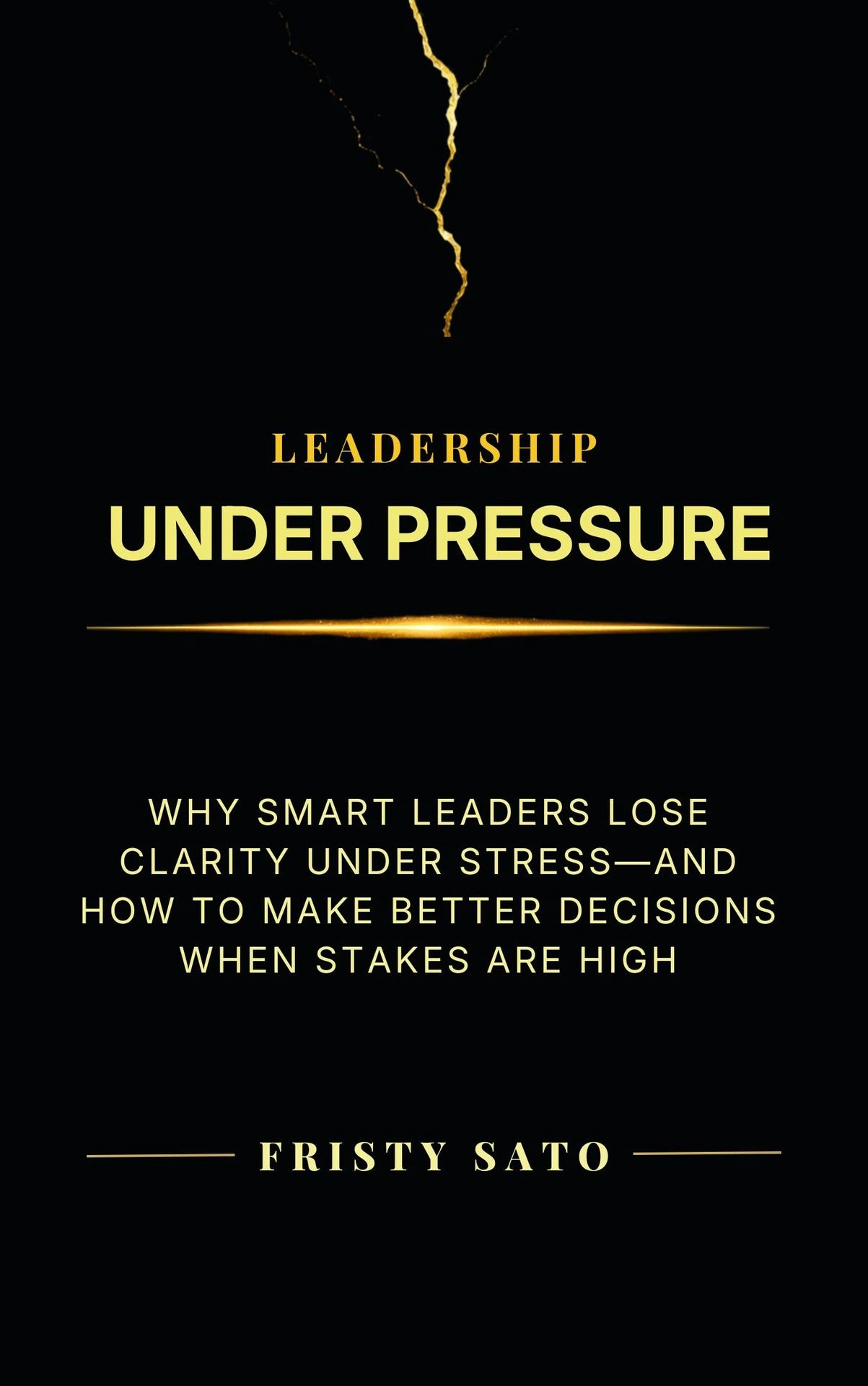
As explored in depth in Leadership Under Pressure: Why Smart Leaders Lose Clarity Under Stress—and How to Stay Clear When Stakes Are High, maintaining clarity requires recognizing when emotional survival instincts are hijacking your judgment.
Executive Presence and Authority
There is a fundamental chasm between performed authority and grounded authority:
Performed Authority relies on posturing: "I need everyone in this room to know that I hold power and control."
Grounded Authority rests on internal security: "I can hold heavy operational responsibility without constantly needing to prove that I am in charge."
Grounded authority grants a leader the freedom to say "I don't know," ask basic questions, listen without immediate pushback, change their position when new data arrives, admit mistakes publicly, delegate effectively, and set firm operational boundaries.
The more secure your authority becomes, the less you need to perform it.
Executive Presence and Visibility
Senior leadership demands visibility: speaking in high-level steering committees, presenting to boards, representing the company externally, taking public positions on controversial initiatives, and attaching your name to major strategic bets.
Yet high visibility frequently triggers deep emotional vulnerabilities. A leader may subconsciously believe:
"If I am seen, I am actively being judged."
"If I speak up, I must be 100% certain, or I will lose credibility."
"If I make a public mistake, my career is finished."
This fear breeds excessive preparation, perfectionism, paralyzing silence, defensive over-explaining, or total avoidance. Often, a perceived lack of executive presence is actually rooted in the fact that visibility simply feels too emotionally expensive.
Executive Presence for Leaders
Leaders navigate unique organizational friction points: maintaining high technical competence while being judged on likability, navigating outdated stereotypes around authority, facing different standards for assertiveness, and bearing invisible relational labor.
Executive presence should never require you to imitate a narrow, rigid archetype of corporate dominance. The goal is not to perform someone else's version of power. It is to develop enough self-trust to occupy your own authority authentically and effectively.
Executive Presence and the Seven Survival-Based Leadership Patterns
Under high-stakes conditions, familiar survival identities distort otherwise brilliant leadership capacity:
The Protective Leader: Over-controls critical initiatives because visibility feels inherently risky.
The Self-Reliant Leader: Struggles to ask for cross-functional support or display vulnerability.
The Strong Leader: Suppresses uncertainty and emotion to maintain an unyielding facade of strength.
The Proving Leader: Over-prepares and over-performs to chase visible validation of competence.
The Achievement-Driven Leader: Equates executive presence with endless output and frantic pacing.
The Capable Leader: Becomes the sole source of answers, inadvertently creating team dependency.
The Responsible Leader: Carries an unsustainable weight of organizational anxiety and relational labor.
Recognizing these patterns transforms them from hidden liabilities into clear signals for internal development.
Executive Presence and Perfectionism
Perfectionism masquerades as rigorous executive preparation. But there is a vital distinction:
Healthy preparation says: "I want to be thoroughly prepared to add value."
Survival preparation says: "I cannot allow myself to be seen until I am entirely bulletproof and impossible to criticize."
Survival preparation breeds crippling delays, exhaustion, overthinking, and a paralyzing fear of making mistakes in public. Credibility requires sound judgment and resilience, not flawless perfection.
Executive Presence and Strategic Thinking
Senior leadership requires moving beyond tactical execution to spot patterns, prioritize competing initiatives, evaluate difficult trade-offs, and make sound decisions amid heavy ambiguity.
Leaders who require absolute certainty before acting inevitably struggle with strategic leadership. Those driven by a need to prove competence often drown themselves in operational details. True strategic presence requires stepping back from the weeds to evaluate the broader system.
Executive Presence and Listening
Strong executives do not merely speak with impact; they master the art of deep listening. They observe subtle patterns, listen to dissenting views without immediate defensiveness, and adjust their stance when evidence warrants it.
Listening without immediate counter-argumentation is a hallmark of elite executive presence that directly reinforces Team Trust and Psychological Safety.
Executive Presence and Difficult Conversations
Presence is tested most severely when agreement vanishes—during hard feedback sessions, board disagreements, performance interventions, and high-stakes negotiations.
An exceptional executive does not need to eliminate relational discomfort. They must remain fully functional inside it.
Executive Presence and Psychological Safety
Psychological Safety governs whether people experience interpersonal safety when speaking up or disagreeing. Executive presence governs credibility, authority, and judgment.
When a leader combines strong executive presence with genuine emotional regulation, they wield authority without turning disagreement into a terrifying threat for their teams.
Executive Presence and Trust
Credibility without trust breeds intimidation. Influence without trust becomes manipulation. Authority without trust forces mere compliance rather than genuine commitment.
People should never have to choose between respecting your authority and feeling safe enough to tell you the unvarnished truth. Cultivate this balance through Ownership and Accountability.
Executive Presence and Delegation
At advanced leadership levels, remaining the central answer source becomes a dangerous liability. If every decision routes through you, team dependency spikes, strategic thinking stalls, and leadership scale collapses.
Executive presence increasingly means building capacity around you rather than demonstrating how much weight you can personally carry.
Executive Presence and Leadership Scale
Early Leadership (Prove execution) → Mid-Level (Lead people) → Senior (Create clarity \& trust) → Executive (Scale capacity beyond yourself)
Your executive value stems from what becomes possible because you are leading—not from how many operational fires you personally put out.
The Executive Presence Loops™
The Grounded Executive Presence Loop™
Clarity → Self-Trust → Discernment → Communication → Action → Relational Impact → Reflection → Greater Clarity
The Survival-Based Executive Presence Loop™
Visibility → Threat Response → Hyper-Self-Monitoring → Performative Execution → Over-Control → Exhaustion
Personal → Leadership → Team → Organizational Lens
- Personal: Confidence, self-trust, emotional regulation, and comfort with visibility.
- Leadership: Communication clarity, strategic judgment, and grounded authority.
- Team: Trust, psychological safety, and independent problem-solving.
- Organization: Leadership pipeline depth, decision velocity, and Organizational Resilience.
How to Develop Executive Presence
- Strengthen clarity: Know your core message before worrying about optics.
- Strengthen judgment: Practice making timely decisions without waiting for 100% certainty.
- Strengthen communication: Eliminate fluff and state what matters with appropriate conviction.
- Strengthen self-trust: Tolerate being visible while imperfect.
- Strengthen emotional awareness: Notice how pressure, visibility, and authority activate your stress reflexes.
- Move beyond details: Train your eye for systemic patterns and trade-offs.
- Embrace grounded authority: Abandon dominance as a proxy for power.
- Engage early: Speak up before your talking points are obsessively polished.
- Welcome dissent: Treat challenge as useful data rather than personal rejection.
- Scale your impact: Build systems and leaders around you so the organization thrives independently.
Practical Reference Guide
| Situation | Survival-Driven Response | Grounded Executive Presence |
| Challenged | Defend immediately | Listen deeply and assess objectively |
| Uncertainty | Pretend absolute certainty | Clearly state what is known and unknown |
| Difficult Question | Over-explain with endless context | Answer directly, then offer brief clarification |
| Senior Disagreement | Avoid conflict or capitulate instantly | Engage respectfully with evidence |
| Public Mistake | Hide, spin, or over-apologize | Own swiftly, extract the lesson, and correct |
| High Pressure | Rush into panicked action | Prioritise ruthlessly and anchor the team |
| Presentation | Perform a flawless persona | Communicate with authentic clarity |
| Decision-Making | Delay until risk is eliminated | Decide decisively with available evidence |
| Delegation | Retain tight micro-control | Transfer genuine authority with guardrails |
Signs You May Need Stronger Executive Presence
- Your technical ideas are consistently stronger than your verbal delivery.
- You reflexively over-explain your rationale or apologize before making a point.
- You hesitate too long before speaking in high-stakes meetings.
- You become noticeably less articulate around senior stakeholders.
- You find strategic, big-picture conversations uncomfortable.
- Team members consistently bring minor decisions back to you rather than deciding independently.
What Executive Presence Should NOT Require
Executive presence does not require you to become louder, more aggressive, emotionally detached, extroverted, or infallible.
You should not have to become less human to become more credible.
Executive Presence and Sustainable Success
When executive presence collapses into constant performance, it generates visibility fatigue, perfectionism, and chronic self-monitoring.Sustainable Success requires occupying your authority without constantly having to prove your worthiness.
Executive Presence Through the Lens of Emotionally Safe Leadership™
Traditional executive presence asks: How can I appear more credible, confident, and influential?
Emotionally Safe Leadership™ asks a deeper question: What emotional patterns make those capabilities easy or difficult for me to access under pressure?
Performing Presence → Developing Clarity → Grounded Authority → Emotionally Safe Leadership™
Final Reflection
Executive presence is frequently described as the ability to look like someone who belongs at the table.
But perhaps the deeper form of executive presence is not proving that you belong. It is becoming secure enough in your leadership that you can actually contribute.
You can listen without disappearing. Speak without performing. Disagree without becoming defensive. Admit uncertainty without collapsing your authority. Make decisions without pretending false certainty.
And lead without turning every high-stakes moment into a desperate test of your worth.
Executive presence is not ultimately about looking powerful. It is about becoming capable of using your authority without ever needing to prove that you deserve it.
Primary Resource: The Emotionally Safe Leadership Assessment™
Discover the underlying emotional patterns shaping how you handle visibility, pressure, and authority.
Focused Growth: Leadership Pattern Breakthrough™ Session
Explore repeated patterns of over-control, overwork, or hesitation in senior meetings with targeted guidance.
Deeper Reading: Leadership Under Pressure
Master practical frameworks to maintain executive clarity and sound judgment when stakes are high.
Free Video Course: The Hidden Emotional Patterns Shaping Your Leadership™
Explore how seven survival-based identities quietly shape your approach to pressure and executive presence.
Continue Exploring Emotionally Safe Leadership™
If this article articulated something you have been experiencing within your own career, you are not alone. The journey toward sustainable, high-impact authority begins by exploring the underlying systems that govern how we show up.
Featured Topics
Sustainable Leadership
Sustainable Success
Sustainable Ambition
Leadership Capacity
Leadership Presence
Executive Presence
Success Without Self-Abandonment
Expansion Without Survival