Imagine a difficult quarter. A major customer walks away, the market shifts overnight, or a leadership transition hits while the workload doubles.
The team responds. Leaders log sixteen-hour days. Employees absorb extra responsibilities on top of already full plates. Problems get solved. The work gets shipped. The organization continues to deliver.
From the outside, it looks resilient.
But look closer. Are critical decisions still bottlenecked by a single person? Are your best people quietly exhausted, wondering how long they can keep this pace up? Can mistakes be discussed openly without fear of a defensive reaction? Can the organization adapt without relying on the exact same few people to save the day?
There is a massive difference between an organization that can withstand pressure and one that has the capacity to learn, adapt, and remain effective when conditions change. In fact, an organization can keep performing under pressure while quietly losing the capacity it needs to perform in the future.
True organizational resilience is not about avoiding difficulty or making every challenge easy. It is about responding to difficulty in ways that preserve and develop your ability to operate, learn, and adapt over time.
What Is Organizational Resilience?
At its core, organizational resilience is an organization's ability to anticipate relevant risks, respond to disruption, adapt to changing conditions, recover from setbacks, and continue creating value over time.
Resilience matters across a wide spectrum of business realities:
Economic uncertainty and sudden market shifts.
The loss of key customers, suppliers, or employees.
Technology failures and cybersecurity incidents.
Leadership transitions and restructurings.
Rapid growth and increasing operational complexity.
Internal conflict, declining trust, or the erosion of key capabilities.
Resilience does not mean preventing every problem. No organization can control every external event. Instead, it means developing the capacity to recognize problems early, respond effectively, learn from what happens, and adjust the systems that shape future performance.
Key Distinction: Resilience is not the ability to ensure that nothing goes wrong. It is the ability to respond when things do go wrong and become better equipped for what comes next.
Organizational Resilience vs. Business Continuity, Risk Management, and Agility
It is easy to conflate resilience with other operational disciplines. While they overlap, they are not interchangeable.
| Concept | Main Question |
| Risk management | What could go wrong, and how can we reduce the likelihood or impact? |
| Business continuity | How do we maintain or restore essential operations during disruption? |
| Crisis management | How do we respond to an urgent, high-impact event? |
| Organizational agility | How quickly and effectively can we adjust to changing conditions? |
| Organizational resilience | Can we withstand disruption, adapt, recover, learn, and continue operating effectively over time? |
Business continuity, risk management, and crisis response support organizational resilience, but resilience is broader than any single plan or process. A continuity plan may help an organization restore operations after a system failure. Organizational resilience also considers whether the organization learns from the failure, reduces future vulnerabilities, and protects the people required to keep operations running.
Why Organizational Resilience Matters
In modern business environments defined by constant change and growing complexity, resilience protects more than just the bottom line. It provides six distinct organizational benefits:
Continuity: Essential work can continue or be restored swiftly after a disruption.
Better decisions: Leaders can respond to problems with clarity rather than falling into reactive panic.
Adaptability: Teams can change direction smoothly when evidence or conditions shift.
Learning: Problems become sources of useful operational data rather than reasons to hide mistakes.
Trust: People can rely on transparent communication and consistent leadership during difficult periods.
Sustainable performance: The organization recovers its capacity instead of repeatedly consuming it.
Better information supports better decisions. Clearer decisions support coordinated action. Trust makes it easier to raise problems early. Learning helps the organization reduce repeated failures.
Resilience is not only about protecting what the organization has built. It is also about protecting its ability to keep building.
The Difference Between Resilience and Endurance
Endurance means continuing despite difficulty. Sometimes that is necessary. But endurance alone does not guarantee that an organization is learning, adapting, or becoming more capable.
When an organization repeatedly responds to problems through longer hours, emergency meetings, individual sacrifice, and leaders stepping in to solve everything, emergency behavior risks becoming the normal operating model.
| Endurance Without Resilience | Organizational Resilience |
| People absorb repeated pressure | The organization investigates recurring pressure |
| Leaders repeatedly rescue operations | Responsibility and decision-making are distributed |
| Problems are solved but not examined | Lessons are used to improve systems |
| Employees work longer to meet demands | Capacity and priorities are reviewed |
| Mistakes are hidden to avoid blame | Problems are raised and addressed |
| Recovery is treated as a personal responsibility | Recovery and continuity are built into how work operates |
| Success depends on a few indispensable people | Critical knowledge and capability are shared |
If your organization survives every crisis only because the same people sacrifice more, you are enduring pressure rather than building resilience.
Individual effort and commitment are valuable. The goal is not to remove effort; it is to stop relying on repeated sacrifice as your primary response to difficulty.
The Hidden Cost of Being “The Resilient One”
Every organization has someone who always steps in. They handle the difficult client, fix the missed deadline, absorb the team's anxiety, or work late to protect the outcome. They are praised as dependable, strong, and indispensable.
Yet when an organization repeatedly relies on these individuals, hidden risks compound:
Knowledge becomes concentrated in a few people.
Teams wait for those same individuals to solve problems instead of exercising judgment.
Leaders become operational bottlenecks.
Exhaustion becomes taboo to admit.
Problems remain hidden until they become critical crises.
When an organization mistakes an individual's ability to tolerate pressure for evidence that the system is healthy, it asks a dangerous question: Is this person making the organization more resilient, or are they protecting the organization from having to become more resilient?
Often, both are true. A capable employee contributes greatly while inadvertently masking a deep structural weakness.
The Four Levels of Organizational Resilience
Resilience is not a monolith. It operates across four interconnected levels:
Personal resilience: The ability to respond to pressure, recover, learn, and make thoughtful choices without relying entirely on suppression, overwork, or avoidance.
Leadership resilience: The ability of leaders to remain clear, make decisions, communicate honestly, regulate their responses, and share responsibility when conditions become difficult.
Team resilience: The ability of a team to coordinate, share information, solve problems, adapt responsibilities, and learn together during disruption.
Organizational resilience: The ability of the wider system to continue essential work, adapt its structures, protect critical capacity, learn from experience, and reduce repeated vulnerabilities.
These levels influence one another, but they are not interchangeable. A highly resilient employee cannot compensate indefinitely for poor organizational design. A strong leader cannot personally create continuity if essential knowledge is held by one person and no backup exists.
Individual resilience matters, but an organization cannot build lasting resilience by asking individuals to compensate for weaknesses in the system.
How Leadership Behavior Shapes Organizational Resilience
Leadership behavior directly dictates what employees learn is safe to do when something goes wrong.
Behaviors that weaken resilience:
Making every important decision personally.
Reacting defensively or punitively to bad news.
Treating mistakes as evidence of incompetence.
Hoarding critical information.
Changing priorities without explaining the underlying trade-offs.
Demanding speed without clarifying realistic boundaries.
Rewarding visible sacrifice more than thoughtful problem-solving.
Taking work back whenever a team struggles.
Behaviors that strengthen resilience:
Making priorities and decision rights crystal clear.
Encouraging the early reporting of risks and near-misses.
Responding to bad news with inquiry before blame.
Sharing knowledge and distributing responsibility.
Maintaining accountability while allowing room for learning.
Reviewing recurring problems rather than repeatedly rescuing the team.
Adjusting plans transparently when evidence changes.
Protecting the capacity required for essential work.
If speaking up leads to humiliation, people hide problems. If every mistake leads to tighter micro-control, employees stop exercising judgment. If leaders take work back whenever pressure rises, teams become permanently dependent.
Psychological Safety and Organizational Resilience
Psychological safety is the shared belief that people can speak up, ask questions, admit mistakes, and raise concerns without unnecessary interpersonal punishment.
During disruption, this becomes mission-critical. Leaders cannot respond effectively to information they never receive. When people feel unsafe, they conceal uncertainty, delay reporting problems, avoid challenging flawed assumptions, or present an artificially rosy picture.
When people can speak honestly, organizations identify risks early and pivot effectively.
An organization cannot respond to problems it has made unsafe to reveal.
Psychological safety does not mean accepting poor performance or removing consequences. It supports honest information and learning; accountability determines what happens next.
Read more on how this functions in Psychological Safety: What It Really Means and Why It Matters at Work.
Trust, Collaboration, and Shared Responsibility
When trust is weak, teams protect their own silos, hoard information, blame other departments, or wait for senior leaders to intervene. When trust is stronger, people ask for help, share risks, coordinate fluidly, and challenge unhelpful decisions.
Resilience grows when people rely on one another, not only when each individual becomes better at handling pressure alone. Cultivating this environment requires reliability, honest cross-team communication, clear ownership, and support that doesn't strip away accountability. Explore related dynamics through Team Trust, Ownership and Accountability, and High-Performing Teams.
The Seven Survival-Based Leadership Patterns Under Pressure
Familiar leadership patterns often become more pronounced when leaders feel threatened, uncertain, or uniquely responsible for protecting the organization.
| Leadership Identity | Possible Response to Disruption | Potential Organizational Cost |
| The Protective Leader | Tightens control to prevent mistakes | Slower adaptation and reduced experimentation |
| The Strong Leader | Hides uncertainty and carries the burden alone | Less honest information and greater team isolation |
| The Responsible Leader | Takes on problems that belong to others | Chronic team dependency and burnout |
| The Capable Leader | Becomes the sole problem-solver | Severe operational bottlenecks and weak succession |
| The Self-Reliant Leader | Avoids depending on others | Fragile collaboration and concentrated knowledge |
| The Proving Leader | Pushes harder to demonstrate competence | Excessive activity and reduced reflection |
| The Achievement-Driven Leader | Prioritizes visible results over recovery | Short-term output at the expense of long-term capacity |
These identities are not fixed personality types. They are coping patterns through which a leader may respond to pressure. The way a leader protects themselves under pressure can quickly become the way an entire organization responds to pressure.
To explore how these dynamics intertwine with personal history, visit our cornerstone overview on Emotionally Safe Leadership™.
The Organizational Resilience Loop™
Organizations typically run on one of two operational cycles when facing disruption:
The Survival Loop
Disruption → Fear→ Centralized Contro l→ Overwork → Temporary Recovery → No Systemic Learning → Repeated Disruption
A crisis occurs, a leader takes control, the team works beyond capacity, and the immediate problem is resolved. Because everyone is exhausted, the organization moves on without examining underlying causes. The exact same vulnerability remains, creating another crisis later.
The Resilience-Building Loop
Disruption → Early Information → Coordinated Response → Recovery & Reflection → Stronger Capacity
Solving the immediate problem is necessary. Learning why the problem kept happening is what prevents the same cycle from becoming your permanent operating model.
Organizational Resilience Requires Both People and Systems
An organization can have committed, adaptable people and still remain fragile if its systems do not support them. Systemic resilience requires:
Clear roles and decision rights.
Adequate staffing and realistic workloads.
Shared knowledge and backup capability.
Reliable operational processes.
Effective cross-team coordination.
If one employee is the sole person who understands a critical process, you have a continuity risk. If every decision requires executive approval, you move too slowly. Resilience is not a personality trait you can hire; it is a structural capacity you must build.
Resilience, Adaptability, and Organizational Change
Resilience includes knowing what to preserve, what to change, and when to wait for better information. Adaptability does not mean changing everything constantly.
Resilient organizations recognize when existing assumptions no longer fit, separate essential priorities from legacy habits, listen to operational feedback, and communicate changes clearly. As explored in Leading Organizational Change, a resilient organization does not simply return to the way things were. It learns whether the old way still serves the reality it now faces.
Innovation and Learning From Failure
Organizations need new solutions when familiar approaches stop working. Yet if mistakes lead to punishment regardless of context, people stop experimenting.
Leaders must distinguish between:
A reasonable experiment yielding an unexpected result.
A preventable mistake revealing a training gap.
Repeated negligence requiring accountability.
A system failure no single person could have prevented.
Treating all mistakes as personal failures prevents learning. Treating all mistakes as acceptable removes responsibility.
Organizational Resilience and Sustainable Performance
A team can deliver strong results during a difficult period while losing the capacity to repeat those results. Meeting deadlines through perpetual overtime, deferred maintenance, and exhausted talent hides future risk.
True resilience aligns with sustainable pacing, clear prioritization, and the ability to stop work that no longer matters. This connects directly to Sustainable Ambition and Leadership Capacity.
Change Fatigue, Burnout, and the Limits of Resilience
You cannot build organizational resilience by teaching people to recover faster from a system that continually exhausts them.
While individual support helps people navigate difficult chapters, leadership changes must reduce unnecessary uncertainty, and systemic updates must address workload and workflow realities. Resilience programs cannot compensate indefinitely for an unhealthy work architecture.
Resilience During Crisis: What Leaders Need to Do
When genuine disruption hits, leaders must anchor their response around five core responsibilities:
Establish what matters most: Identify essential operations and immediate risks.
Communicate what is known: Share the situation candidly, including what remains uncertain.
Distribute responsibility: Give capable people clear authority to act.
Maintain honest information flow: Make it safe to surface bad news early.
Review and recover: Once the immediate crisis passes, examine what happened and restore operating capacity.
How to Build Organizational Resilience Before a Crisis
Preparation increases your options when conditions shift:
Identify critical single points of failure.
Clarify decision rights across teams.
Develop leadership depth.
Create reliable channels for surfacing risks.
Review workloads and operating capacity regularly.
Build reflective learning into daily operations.
How to Measure Organizational Resilience
Evaluate your organization across multiple interconnected dimensions:
Preparedness: Are critical risks and dependencies understood?
Continuity: Can essential operations recover within acceptable limits?
Adaptability: Can priorities shift smoothly when conditions change?
Information flow: Are risks and mistakes raised early enough to act?
Shared capacity: Is knowledge distributed, or concentrated in a few individuals?
Human sustainability: Can the organization respond without relying on chronic overwork?
Warning Signs That an Organization Is Less Resilient Than It Appears
Look for these operational red flags:
One leader must approve nearly every important decision.
A few employees carry critical, undocumented knowledge.
Teams routinely solve the exact same problems month after month.
Bad news arrives late because people fear the reaction.
Recovery periods after heavy sprints are consistently postponed.
Good results depend entirely on people working beyond reasonable capacity.
If the people who currently hold everything together became unavailable tomorrow, how much of the organization's capability would remain?
Resilience and the Emotionally Safe Organization™
Conventional resilience practices focus on risk, continuity, and crisis response. Emotionally Safe Leadership™ adds attention to the emotional patterns shaping leadership behavior. The Emotionally Safe Organization™ extends that perspective to the systems and relationships governing daily work.
An emotionally safe organization is not one that never experiences pressure. It is one where pressure does not automatically lead to fear, silence, over-control, or the exhaustion of its people.
The Five Conditions for Sustainable Organizational Resilience
To build an organization capable of navigating persistent uncertainty without burning out its people, we must synthesize system design with leadership behavior. Grounded in the Emotionally Safe Leadership™ framework, these five core conditions serve as an organizing structure for systemic reflection:
Safety to Surface Reality + Trust & Shared Responsibility + Clear Direction & Authority + Sustainable Capacity + Learning & Adaptation = Sustainable Organizational Resilience
                        ┌────────────────────────────────────────────────┐
                        │      Sustainable Organizational Resilience     │
                        └───────────────────────┬────────────────────────┘
                                                │
         ┌──────────────────┬───────────────────┼───────────────────┬──────────────────┐
         │                  │                   │                   │                  │
         ▼                  ▼                   ▼                   ▼                  ▼
┌─────────────────┐ ┌───────────────┐ ┌───────────────────┐ ┌───────────────┐ ┌────────────────┐
│    Safety to    │ │    Trust &    │ │  Clear Direction  │ │  Sustainable  │ │   Learning &   │
│ Surface Reality │ │    Shared     │ │    & Authority    │ │   Capacity    │ │   Adaptation   │
│                 │ │ Responsibility│ │                   │ │               │ │                │
└─────────────────┘ └───────────────┘ └───────────────────┘ └───────────────┘ └────────────────┘
1. Safety to Surface Reality
Employees must feel secure enough to report risks, acknowledge mistakes, air uncertainties, and surface uncomfortable truths early enough for the organization to pivot effectively. Without safety, leadership operates in an echo chamber of false optimism.
2. Trust and Shared Responsibility
Teams must be able to depend on one another, coordinate smoothly across cross-functional boundaries, and take collective ownership of outcomes. Trust eliminates the friction of defensive politics and bureaucratic over-control.
3. Clear Direction and Authority
People at every level require crystal-clear understanding regarding organizational priorities, decision rights, and boundaries. When individuals know what they own—and when to escalate—they act decisively without waiting for permission.
4. Sustainable Capacity
The organization must actively protect its operational capacity, ensuring that teams have the staffing, resources, skill sets, time, and structured recovery periods needed to maintain high performance without chronic exhaustion.
5. Learning and Adaptation
The organization systematically uses evidence, operational data, and experience to refine its workflows and strategies. Rather than relying on heroic emergency sprints, the business matures through intentional systemic iteration.
Note: This conceptual framework illustrates the optimal conditions for sustainable performance. While not an exhaustive formula for every external crisis, these five pillars dramatically strengthen an organization’s underlying adaptability.
The Future of Organizational Resilience
As markets evolve, technologies shift, and workforce expectations transform, the definition of organizational success is fundamentally changing. The legacy response to disruption—demanding that employees work harder, adapt faster, and display greater personal toughness—is proving obsolete.
Organizations can no longer treat human energy as an infinite resource.
The future belongs to companies that develop deep leadership pipelines, high-trust cultures, flexible decision structures, and robust learning systems. True resilience is not simply returning to the state that existed before a crisis. In many cases, a crisis reveals that the previous state was already dangerously fragile.
Building a resilient business may require rethinking decision rights, decentralizing critical knowledge, rebalancing workloads, cultivating Emotionally Safe Leadership™, or abandoning legacy habits that generate hidden risk.
The future belongs not simply to organizations that can withstand more pressure, but to organizations that can learn, adapt, and become more capable without making human exhaustion the price of survival.
Take the Next Step Toward Resilient Leadership
When market disruption hits, your unconscious leadership patterns become amplified. Understanding how you react under stress is the first step toward building an adaptable, high-performing system.
Discover the Emotional Patterns Shaping Your Leadership
Discover what drives your decision-making, communication, and response to pressure before temporary stress turns into systemic burnout.
Take a Free Leadership Course
Explore why high-performing leaders feel over-responsible, exhausted, or bottlenecked—and discover how emotional safety transforms leadership capacity and team ownership across five practical modules.
Take The Hidden Emotional Patterns Shaping Your Leadership™ Free Course on Udemy
Deepen Your Perspective
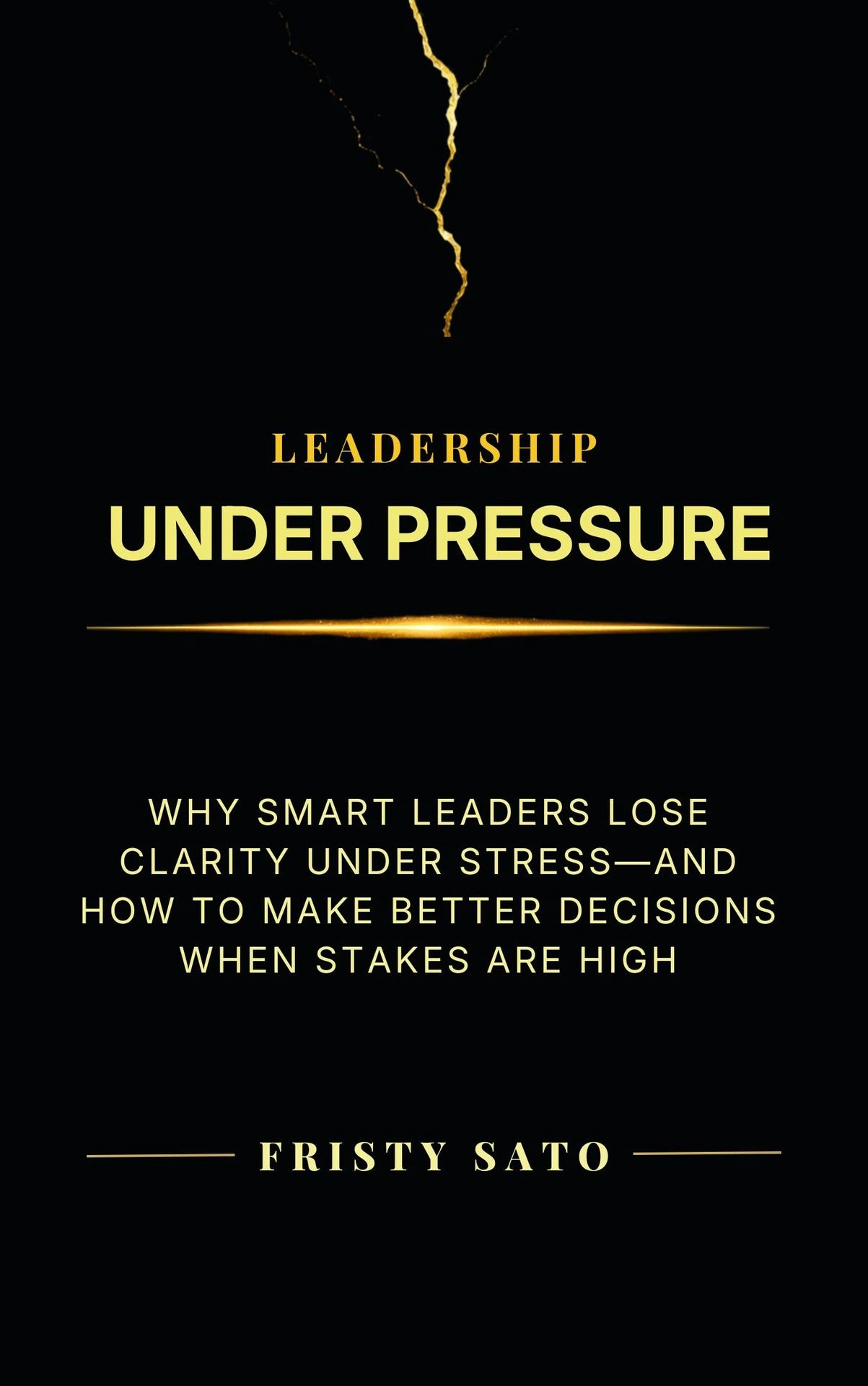
Learn why smart leaders lose clarity during high-stakes situations—and master practical techniques to maintain strategic focus, make confident decisions, and keep your teams grounded when conditions shift, explore Fristy's book, Leadership Under Pressure: Why Smart Leaders Lose Clarity Under Stress—and How to Stay Clear When Stakes Are High.
Ready to dismantle the hidden operational bottlenecks in your organization?
Book a private, 90-minute Leadership Pattern Breakthrough™ Session with Fristy Sato to map your nervous system patterns directly against your current org chart and team performance.
Reader Learning Journey
To continue deepening your organizational architecture, follow this recommended reading sequence:
Organizational Resilience → Leading Organizational Change → Psychological Safety → Team Trust → Ownership & Accountability → High-Performing Teams → Healthy Workplace Culture → Emotionally Safe Leadership™ → Emotionally Safe Organization™
Leading Organizational Change: Learn how to lead smooth organizational pivots during times of transition.
Psychological Safety: Build an environment where bad news and operational risks are reported early.
Team Trust: Eliminate cross-departmental friction and establish deep operational alignment.
Ownership and Accountability: Empower your teams to make sound decisions without constant executive oversight.
High-Performing Teams: Sustain excellent execution without burning out your best talent.
Healthy Workplace Culture: Design systemic norms that reinforce human dignity, growth, and long-term performance.
Continue Exploring Emotionally Safe Leadership™
If this article articulated something you have been experiencing within your own career, you are not alone. The journey toward sustainable, high-impact authority begins by exploring the underlying systems that govern how we show up.
Featured Topics