Organizations constantly say they want:
innovation
creativity
fresh ideas
experimentation
disruption
new ways of thinking
But what happens when someone proposes an idea that might fail? What happens when an employee challenges the leader? What happens when the experiment does not work? What happens when someone says, "I think we're solving the wrong problem"? What happens when a junior employee has a better idea than the most senior person in the room? What happens when the team needs time to explore before knowing the answer?
Many organizations want the outcomes of creativity without creating the conditions creativity requires. You cannot build an innovative organization by rewarding only certainty, speed, agreement, and successful outcomes.
What Is Creativity?
Creativity is the ability to generate, connect, reframe, imagine, or explore possibilities that are not immediately obvious.
It includes:
generating ideas
seeing connections
reframing problems
asking better questions
imagining alternatives
challenging assumptions
approaching familiar problems differently
Creativity is not limited to artists, designers, writers, or marketing teams. It appears in strategy, engineering, operations, leadership, customer experience, problem-solving, product development, and organizational design.
Important: Creativity is not a personality type. It is a human capacity.
What Is Innovation?
Innovation is the process of developing and applying new or improved ideas in a way that creates meaningful value.
Creativity asks: "What else could be possible?"
Innovation asks: "How could we turn this possibility into something useful?"
Innovation involves experimentation, implementation, learning, adaptation, resource decisions, risk assessment, and iteration. This prevents the article from treating innovation as simply having good ideas.
Creativity vs Innovation
| Creativity | Innovation |
| Generates possibilities | Applies possibilities |
| Explores | Experiments |
| Imagines | Tests |
| Reframes | Implements |
| Asks “What if?” | Asks “How might this work?” |
| Expands options | Creates value |
| Can remain conceptual | Requires action |
Organizations need both. Creativity without implementation can remain ideas. Innovation without creativity can become incremental improvement without meaningful new thinking.
Why Smart Teams Stop Being Creative
Organizations often have intelligent, experienced people who stop contributing original ideas. Why?
previous ideas were dismissed
mistakes were punished
leaders reacted defensively
hierarchy was strong
people learned what the leader wanted to hear
speed was rewarded more than exploration
workload left no mental space
people feared looking incompetent
disagreement was treated as disloyalty
experimentation was punished when it failed
only successful ideas received recognition
When people learn that being wrong is expensive, they become very good at being safe.
Psychological Safety and Innovation
Innovation requires interpersonal risk. People may need to say:
"I don't understand."
"I disagree."
"What if we're wrong?"
"Could we try something completely different?"
"I have an idea, but I'm not sure it will work."
"I think our current approach is creating the problem."
"I made a mistake in the experiment."
If those statements create punishment, embarrassment, or dismissal, people learn to filter themselves.
Psychological safety does not guarantee innovation. It makes the interpersonal risk of contributing new thinking more manageable. It does not mean every idea is good, every experiment should continue, standards disappear, or leaders must agree. It means people can contribute ideas and information without unnecessary interpersonal threat. (Read more in our core guide on Psychological Safety).
Innovation Requires Healthy Failure
Do not romanticize failure. Some failures are expensive and avoidable. But innovation requires learning from experiments, and experiments cannot all produce the desired outcome.
Unhealthy cultures ask: "Who caused this?"
Healthy cultures ask: "What does this tell us?"
Psychological safety makes it easier to discuss failure. It does not remove responsibility for learning from it. (Connected to Ownership and Accountability).
The Emotional Cost of Being Wrong
Creativity requires uncertainty. Uncertainty can activate fear of judgment, shame, perfectionism, the need for control, the need to prove competence, fear of disappointing others, and fear of losing status.
Therefore, a leader may unintentionally shut down creativity even while verbally encouraging it. A leader says they want creativity, but when someone proposes an unusual idea, they reply: "That's unrealistic," or "We've already tried that," or "We don't have time for this."
People learn whether creativity is safe from what happens after they use it.
Leadership Patterns That Can Suppress Innovation
When leaders operate from unconscious survival patterns—such as the Protective Leader, the Strong Leader, the Capable Leader, the Proving Leader, the Achievement-Driven Leader, the Responsible Leader, or the Self-Reliant Leader—they often create environments of low uncertainty tolerance, premature solutions, defensive reactions, and over-control. These patterns are understandable ways of creating safety, but when they become the team's environment, innovation stalls.
The Personal → Leadership → Team → Organizational Lens
- Personal: Leader experiences fear of failure, need for control, pressure to know, and fear of looking incompetent.
- Leadership: Leader shuts down ideas, over-directs, asks for certainty too early, and becomes defensive.
- Team: Team stops suggesting ideas, waits for instructions, avoids disagreement, and shares only safe ideas.
- Organization: Organization experiences low innovation, slow adaptation, missed opportunities, and groupthink.
The Creativity-Safety Loop
Healthy Loop: Psychological Safety → Curiosity → Ideas → Experimentation → Learning → Better Ideas → Innovation → Trust
Self-Protection Loop: Fear of Judgment → Self-Censorship → Fewer Ideas → Less Experimentation → Less Learning → Lower Innovation → More Control → Greater Fear
Creativity Requires Space
A constantly overloaded team may not lack creativity. It may lack the capacity to access it. Workload, constant interruptions, excessive meetings, chronic urgency, and lack of recovery crowd out the cognitive space needed to notice patterns and make connections. (Learn more: Employee Engagement, Burnout, and Sustainable Performance).
Innovation and High-Performing Teams
High-performing teams need both execution (consistency, standards, delivery, reliability) and exploration (experimentation, questioning, new ideas, learning). A team that only executes becomes efficient at doing yesterday's work, while a team that only explores may fail to deliver. (Learn more: High-Performing Teams).
Innovation and Healthy Conflict
Innovation requires disagreement. Thoughtful creative conflict exposes blind spots, improves ideas, challenges assumptions, and generates alternatives. Unhealthy conflict turns difference into personal threat and silence. (Learn more: Team Trust).
Innovation and Trust
Trust makes it easier to share unfinished ideas, admit uncertainty, challenge assumptions, ask for help, and experiment together. Without trust, people optimize for looking competent instead of discovering what is true.
Innovation and Accountability
Innovation is not an excuse for irresponsibility. Psychological safety allows experimentation; accountability makes experimentation purposeful. Innovation needs enough freedom to explore and enough structure to learn.
Innovation and Employee Engagement
People contribute ideas when they experience meaning, ownership, trust, influence, recognition, and connection. Engagement includes the experience that your thinking matters. (Learn more: Employee Engagement).
Why Innovation Programs Often Fail
Workshops, brainstorming sessions, idea platforms, awards, hackathons, and creativity training cannot fix fear, poor leadership, excessive workload, lack of decision authority, low trust, or rigid hierarchy.
You cannot create an innovative culture by scheduling creativity into an otherwise unsafe system.
Why Brainstorming Alone Does Not Create Innovation
Brainstorming generates ideas. Innovation requires problem definition, evaluation, experimentation, resources, decision-making, iteration, implementation, and learning.
The real question is not: "How many ideas did we generate?" It is: "What happens to a good idea after someone has the courage to propose it?"
Building a Culture of Innovation
- Make questioning legitimate: Reward good questions, not just fast answers.
- Make disagreement usable: Do not punish thoughtful challenge.
- Separate ideas from identity: A rejected idea should not become a rejected person.
- Make experimentation possible: Create appropriate room for testing.
- Clarify risk boundaries: Not every decision requires the same level of caution.
- Protect learning: Discuss failed experiments without unnecessary blame.
- Give people authority: Do not ask for innovation while requiring permission for everything.
- Protect cognitive capacity: Do not overload people and then demand creativity.
- Reward useful learning: Not only successful outcomes.
- Model uncertainty at leadership level: Leaders should be able to say, "I don't know yet."
What Leaders Can Do Differently
Instead of asking "Who has an idea?" leaders can ask:
"What are we assuming?"
"What might we be missing?"
"What would we do if our current approach were unavailable?"
"What are we afraid to say?"
"Where might the current process be creating the problem?"
"What would we test if failure were inexpensive?"
"What information would change our mind?"
"Who sees this differently?"
"What does the least senior person in the room notice?"
Innovation Under Pressure
Pressure often reduces curiosity, patience, exploration, and cognitive flexibility. Leaders under pressure narrow options, become certain, centralize decisions, and reject unusual ideas. (Connected to Leadership Under Pressure and Decision Making Under Pressure).
Innovation and Decision-Making
Leaders must balance exploration decisions ("What could we try?") with commitment decisions ("What will we actually do?"). Poor cultures suffer from premature certainty or endless exploration without action.
Signs Your Organization Has an Innovation Problem
- Employees say, "That's not how we do things."
- People stop proposing ideas.
- Only senior leaders generate new ideas.
- Meetings contain agreement but little challenge.
- People wait for permission.
- Failed experiments are remembered longer than successful learning.
- People hide uncertainty.
- Everyone is too busy to think.
Signs of a Healthy Innovation Culture
- People asking difficult questions.
- Ideas coming from different levels.
- Respectful disagreement.
- Experiments happening at appropriate scale.
- Leaders admitting uncertainty.
- People changing their minds when evidence changes.
- Ideas being tested rather than endlessly debated.
Innovation and the Emotionally Safe Organization™
An organization's innovation capacity is partly a reflection of what its system allows people to safely think, say, test, and learn.
Five Conditions for Sustainable Innovation
Safety: People can contribute ideas without unnecessary interpersonal threat.
Curiosity: People are encouraged to question assumptions.
Ownership: People have enough authority to act on useful ideas.
Capacity: People have enough cognitive and emotional space to think.
Learning: The organization can learn from both success and failure.
Safety + Curiosity + Ownership + Capacity + Learning = Sustainable Innovation
Innovation Does Not Mean Constant Change
Innovation is not changing everything, chasing trends, or disrupting for the sake of disruption. Sometimes innovation means simplifying, removing something, improving a process, or solving a customer problem.
Creativity and Innovation Are Human Capacities
The question is not whether your people are creative. The question is what happens to their creativity when it enters your organization.
Final Reflection
Organizations often ask people to innovate when what they have actually created is an environment optimized for certainty. Creativity needs room to explore. Innovation needs room to experiment. Learning needs room to be wrong. And people need enough emotional safety to do all three.
The future of innovation may depend less on teaching people how to be creative and more on building organizations that do not teach people to hide their creativity.
Discover the Emotional Patterns Shaping Your Leadership
If you are looking to audit your own leadership patterns that may be influencing your team's dynamics, take our Free Emotionally Safe Leadership Assessment™.
Take a Free Leadership Course
To transform your team’s operating system from the root up, explore our course: The Hidden Emotional Patterns Shaping Your Leadership™.
Take The Hidden Emotional Patterns Shaping Your Leadership™ Free Course on Udemy
Explore The Book
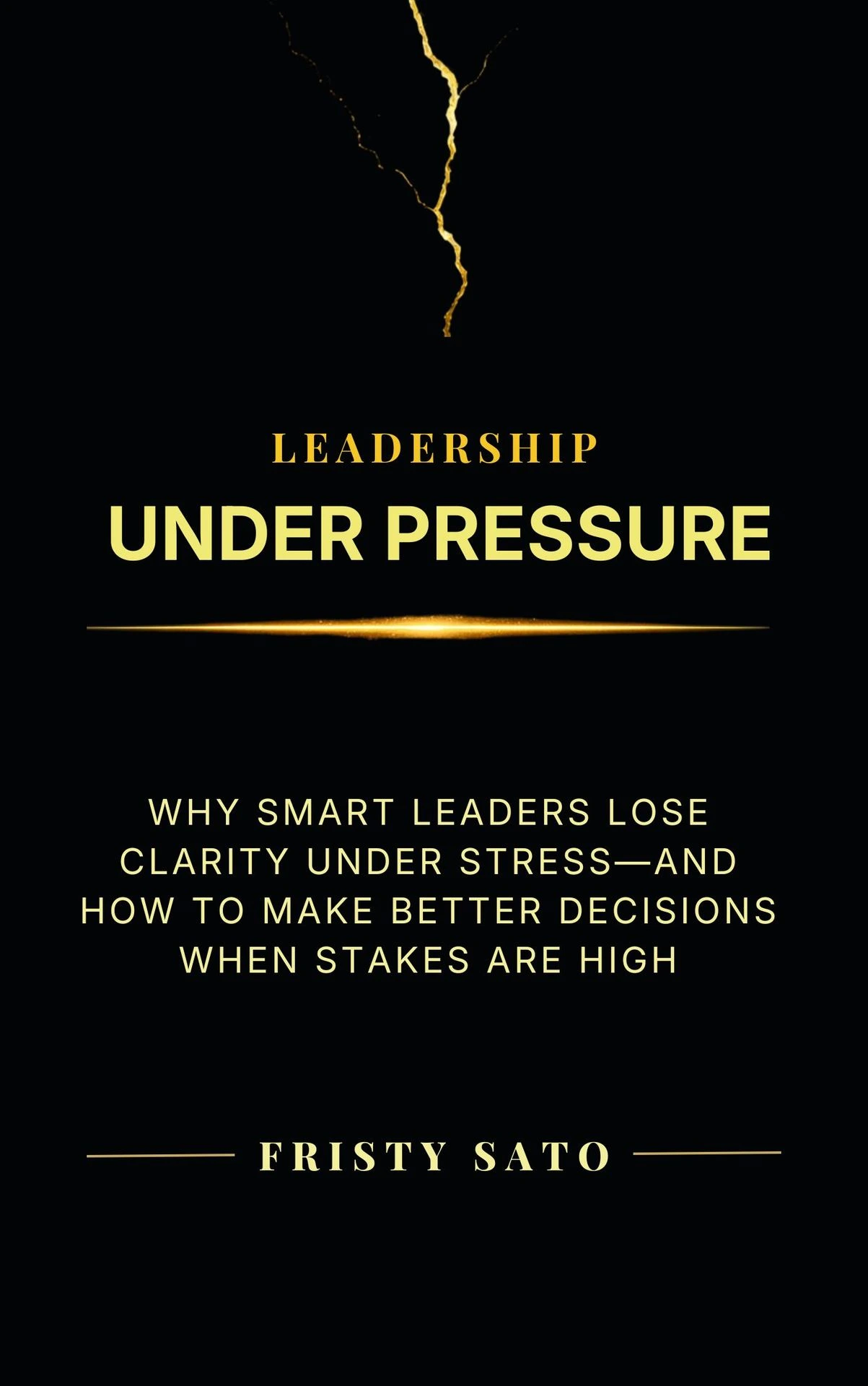
For a deeper dive into the leadership mindset required under stress, explore the book Leadership Under Pressure: Why Smart Leaders Lose Clarity Under Stress—and How to Stay Clear When Stakes Are High by Fristy Sato.
Ready to dismantle the hidden operational bottlenecks in your organization?
Book a private, 90-minute Leadership Pattern Breakthrough™ Session with Fristy Sato to map your nervous system patterns directly against your current org chart and team performance.
Continue Exploring Emotionally Safe Leadership™
If this article articulated something you have been experiencing within your own career, you are not alone. The journey toward sustainable, high-impact authority begins by exploring the underlying systems that govern how we show up.
Featured Topics
Healthy Workplace Culture
Team Trust
Psychological Safety
Employee Engagement
Ownership and Accountability
High-Performing Teams
Innovation and Creativity
Leading Organizational Change
Organizational Resilience