A major client may leave. A key employee resigns. Revenue suddenly drops. A serious mistake happens. A public problem emerges. A major investment has to be approved. A team member challenges a decision.
You have incomplete information, and people are waiting for you to decide.
You know how to make decisions. You do it every day. But this decision feels different.
Suddenly, your internal rules change:
you need more information than humanly possible
you cannot stop thinking about the worst-case consequences
you want everyone to agree so you don't stand alone
you become unusually cautious, or you decide too quickly just to end the agony
you start questioning decisions you normally would trust implicitly
you take a decision back from your team because it feels too risky to let them hold it
you become hyper-focused on avoiding blame
And then comes the quiet, exhausting reframe: We often assume pressure makes decision-making harder simply because there is more at stake.
But what if pressure also changes what the decision means to us?
A decision can stop being simply: “What is the best thing to do?” And become: “What will this decision say about me?”
That is where clarity begins to disappear.
What Does Decision Making Under Pressure Mean?
Let’s define the concept simply. Decision making under pressure is the process of choosing a path when time is short, consequences feel massive, information is missing, uncertainty is high, and other people are watching.
Mistakes feel costly. Emotions run hot.
Here is an important truth: Pressure is not automatically bad. A healthy dose of pressure sharpens attention and creates useful urgency.
The issue isn't pressure itself. The issue is what happens when pressure becomes emotionally overwhelming or activates an old survival pattern. That is when pressure stops being a management challenge and becomes an emotional activation.
Why Pressure Changes Decision-Making
When the stakes spike, your nervous system responds before your logic does. Pressure changes:
your attention (narrowing it down to immediate threats)
your risk perception (making worst-case scenarios look guaranteed)
your tolerance for uncertainty
your willingness to ask for input
your confidence and time horizon
your ability to consider multiple options
Under pressure, a leader often becomes singularly focused on removing immediate discomfort rather than choosing the strongest long-term response.
Under pressure, the decision you want to make and the discomfort you want to escape can become very easy to confuse.
The Difference Between a Difficult Decision and a Pressure-Driven Decision
Not every difficult decision is a bad decision.
A difficult decision involves real trade-offs, competing priorities, and significant consequences. That is just part of leadership.
A pressure-driven decision, however, happens when the emotional need to reduce a perceived threat starts shaping the choice more than the actual situation requires.
For example, a leader chooses certainty over opportunity, speed over thoughtfulness, control over ownership, or avoiding blame over telling the truth. The surface mechanics look like strategy, but the engine driving them is emotional self-protection.
The Pressure-to-Decision Cycle
To understand how this happens, look at the chain reaction:
Pressure → Emotional Activation → Interpretation (“What does this mean?”) → Urgency / Threat (“What needs to happen right now?”) → Decision-Making Pattern (Control / Overthinking / Proving)→ Decision→ Leadership Behavior → Team Response → Organizational Outcome
Clarity does not require the absence of pressure. It requires enough space to notice what pressure is making you prioritize.
Why Smart Leaders Lose Clarity Under Pressure
Intelligence does not make someone immune to pressure. Experience does not make someone immune to pressure. Success does not make someone immune to pressure.
In fact, high-responsibility leaders often experience more emotionally loaded decisions because more people, money, and reputations are attached to their choices.
You can intellectually know: "I don't need to have all the information to move forward." But emotionally, your body experiences: "If I don't know enough, I might make the wrong choice, and everyone will see it."
That gap matters.
Sometimes the problem is not a lack of decision-making ability. It is that pressure changes the emotional conditions under which that ability has to operate.
When the Decision Becomes About You
This is where high-stakes decisions turn into identity questions.
Instead of asking: “Should we launch this product?” The internal dialogue becomes: “What if this fails and everyone realizes I was wrong?”
Instead of: “Should I delegate this project?” It becomes: “What if they mess up and I am the one blamed?”
Instead of: “Should we change direction?” It becomes: “What if changing direction proves my first decision was a mistake?”
The more a decision becomes evidence about who you are, the harder it becomes to evaluate the decision itself.
The Seven Survival-Based Leadership Patterns Under Pressure
Pressure doesn't affect every leader the same way. It amplifies your default survival adaptation:
The Responsible Leader: Thinks, "If I make the wrong call, everyone suffers." Pattern: Over-responsibility, excessive checking, and difficulty sharing ownership.
The Strong Leader: Thinks, "I should already know what to do." Pattern: Emotional suppression, isolation, and faking certainty.
The Capable Leader: Thinks, "I should be able to solve this myself." Pattern: Over-analysis, firefighting, and avoiding input.
The Self-Reliant Leader: Thinks, "It’s faster if I decide alone." Pattern: Hoarding decisions and excluding others.
The Protective Leader: Thinks, "I need to make sure nothing goes wrong." Pattern: Over-control and extreme risk aversion.
The Proving Leader: Thinks, "This decision must prove my competence." Pattern: Analysis paralysis and fear of visible mistakes.
The Achievement-Driven Leader: Thinks, "We cannot afford to lose momentum." Pattern: Choosing action simply because stopping feels like failure.
The decisions look different on the surface. The emotional function underneath them is identical: creating enough safety to move forward.
Decision Making Under Pressure and Uncertainty
Uncertainty is not the same as danger. But emotionally, uncertainty can easily be experienced as danger.
When that happens, leaders seek endless data, delay commitments, demand absolute guarantees, or control every step of implementation.
Clarity is not the same as certainty. Good leadership often means making a clear decision with incomplete information rather than waiting for a level of certainty that does not exist.
Decision Making Under Pressure and Emotions
Emotion is not the enemy of good decision-making. Emotions give us vital data about values, risk, relationships, and boundaries.
The trick is learning this distinction: Emotion vs. emotional impulse.
A feeling can inform a decision without dictating it. Emotion can be data without becoming the decision-maker.
Fear of Making the Wrong Decision
The fear of being wrong creates perfectionism, excessive consultation, and post-decision rumination.
The goal of leadership is never to make decisions that can never be wrong. The goal is to become capable of making responsible decisions when certainty is impossible.
Overthinking Under Pressure
Sometimes overthinking isn't a search for better data. It’s an attempt to find a decision that carries zero emotional risk.
The leader keeps thinking because they believe another round of analysis will finally remove the possibility of regret. Instead, it creates more scenarios, more fear, and more self-doubt.
Decision Paralysis vs. Impulsive Decisions
Pressure creates two extremes: too little time spent thinking, or too much.
Some leaders rush because they want the emotional discomfort to end. Others delay because they want guarantees before committing. Both are attempts to regulate discomfort.
Avoiding a decision and making a rushed decision come from the exact same place: wanting to escape the emotional discomfort of uncertainty.
How Pressure Affects Risk
Pressure distorts risk perception. One leader becomes excessively conservative, seeing only what could go wrong. Another becomes reckless, confusing unfamiliarity with excitement.
Different patterns move leaders in opposite directions, but the core truth remains: Pressure changes the emotional meaning of risk.
How Pressure Affects Team Decision-Making
A leader under pressure stops asking for input, makes all decisions alone, reverses delegation, and becomes intolerant of disagreement.
Your team learns from this immediately. People stop taking ownership, wait for instructions, hide uncertainty, and avoid speaking up.
One leader's inability to tolerate uncertainty can become an entire team's inability to make decisions.
Decision Making and Psychological Safety
Psychological safety helps people speak up and admit uncertainty. But psychological safety doesn't mean everyone agrees, and emotionally safe leadership doesn't mean avoiding hard choices.
An emotionally safe leader can make a decision without requiring everyone to agree, and can hear disagreement without experiencing it as a threat to their authority.
How to Make Better Decisions Under Pressure
Here is a practical, grounded way to restore clarity when the stakes are high:
Separate the facts from the emotional meaning: What actually happened? What am I afraid this means about me?
Name what pressure is making urgent: What feels like it must happen right now? Does it actually?
Identify what you are trying to protect: Is it the business, your team, your reputation, or your need to be right?
Identify the pattern: Am I controlling, overthinking, avoiding, or proving?
Return to the actual decision: What response best serves the situation—not what makes you feel safest?
Decide what must be decided now: Not every part of the problem needs immediate resolution.
Define what data genuinely changes the choice: This stops endless research loops.
Decide who needs to be involved: Do not confuse leadership with making every choice alone.
Make the decision: Accept that uncertainty will remain.
Communicate clearly: Explain what was decided, why, what comes next, and what remains uncertain.
What Clear Decision-Making Under Pressure Looks Like
Not: "I know exactly what will happen." But: "I don't know everything that will happen, but I know enough to make a responsible choice right now."
Not: "Nobody can disagree with this." But: "I've heard the concerns, and I still believe this is the right direction."
Not: "If this fails, I failed." But: "If this doesn't work, we will learn, adjust, and respond."
Clarity Is Not Certainty
Certainty: "I know this will work."
Clarity: "I understand what matters, what I know, what I don't know, and what I am choosing."
Clear leadership does not require a crystal ball. Sometimes clarity simply means knowing what you do not know and deciding anyway.
What Emotionally Safe Leadership™ Changes
Emotionally Safe Leadership doesn't mean never making mistakes or making everyone happy.
It allows leaders to make responsible decisions without requiring the decision to protect their identity.
An emotionally safe leader can say: "I may be wrong. I don't know yet. I need another perspective. I've changed my mind. This decision is mine to make."
That is authority without rigidity.
Reflection: What Happens to Your Decisions When Pressure Rises?
- What happens to my decision-making when the stakes become high?
- Do I become slower or faster?
- Do I seek more information than I actually need?
- Do I stop asking for input?
- Do I need everyone to agree?
- Do I become more controlling?
- Do I make decisions simply to end uncertainty?
- What am I most afraid this decision might say about me?
- What am I trying to protect?
- What would I choose if I did not need the decision to prove anything about my competence?
- What information genuinely matters?
- What would clear leadership look like here?
The Bigger Question
We often think better decision-making comes from gathering more data. Sometimes it does. But often, the information is already enough.
What’s missing is the ability to stay clear while uncertainty remains.
The question is not always: “How can I become better at making decisions?”
Sometimes it is: “Who do I become when I am afraid of making the wrong one?”
That is the bridge to Leadership Under Pressure.
Featured Resource: Leadership Under Pressure
High-pressure decisions reveal more than your strategic skills. They reveal what pressure activates inside you.
In Leadership Under Pressure: Why Smart Leaders Lose Clarity Under Stress—and How to Stay Clear When Stakes Are High, Fristy Sato explores why capable leaders lose clarity when the stakes are high, why familiar survival patterns take over, and how leaders can develop the capacity to stay clear without needing certainty first.
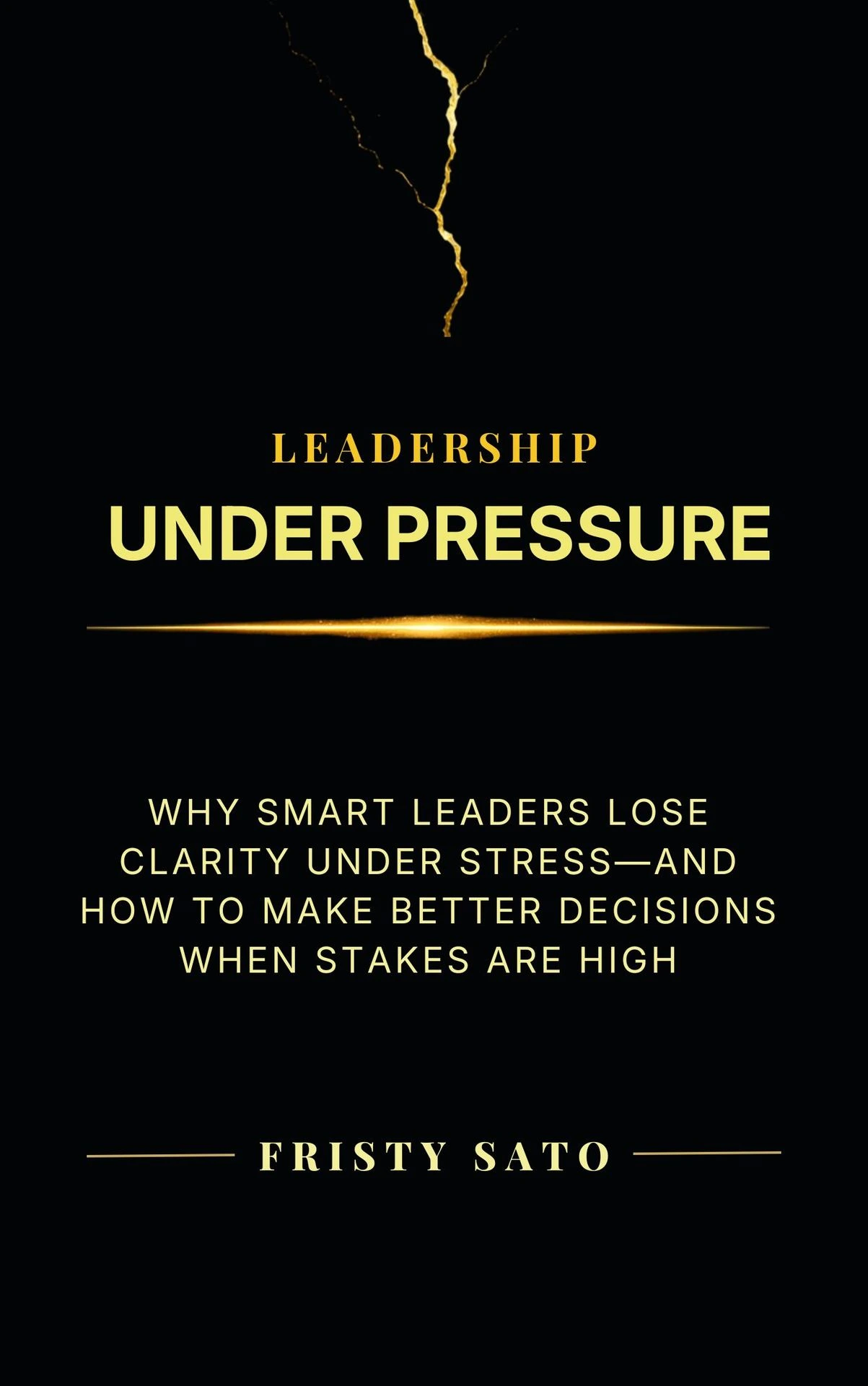
“You do not need to know exactly what will happen. You need to remain clear enough to decide what to do next.”
Discover Your Leadership Pattern
Curious how your nervous system shapes your leadership under pressure? Take the free 3-minute Emotionally Safe Leadership Assessment™ to uncover your dominant survival-based pattern, identify hidden blind spots, and learn how your internal state impacts your team's performance.
Ready to dismantle the hidden operational bottlenecks in your organization?
Book a private, 90-minute Leadership Pattern Breakthrough™ Session with Fristy Sato to map your nervous system patterns directly against your current org chart and team performance.
Continue Exploring Emotionally Safe Leadership™
If this article articulated something you have been experiencing within your own career, you are not alone. The journey toward sustainable, high-impact authority begins by exploring the underlying systems that govern how we show up.
Featured Topics