Imagine this familiar scenario.
A key team member directly questions your strategic decision in front of executive stakeholders. Or perhaps an expensive operational error is made right before a major launch. A high-value client threatens to walk away. Or maybe you are simply exhausted after a ten-hour day, and someone walks into your office bringing you yet another volatile problem to solve.
You know how you should respond. You understand management theory. You have read the books on executive presence.
But internally, something shifts.
Before your logical mind can formulate a measured, thoughtful response, your nervous system takes over. Your heart rate accelerates. Your chest tightens. Suddenly, an automatic leadership response kicks in:
You become sharp and defensive, arguing your point to prove you were right.
You tighten control, taking the project back to fix it yourself.
You speak faster, over-explaining your reasoning to justify your authority.
You go completely quiet, shutting down the conversation to prevent further conflict.
You create an immediate sense of artificial urgency, demanding everyone fix the issue this second.
Afterward, when the dust settles, you replay the moment in your mind. You wonder why you lost your composure, or why a simple conversation felt like a high-stakes battle.
We often assume that emotionally mature leaders simply know how to control their emotions.
But what if emotional regulation is not about controlling what you feel? What if it is about creating enough space between what you feel and what you do next?
The goal of emotional regulation in leadership is not to become an unshakeable robot. The goal is to stay clear enough to lead well, even when you are fully activated.
What Is Emotional Regulation?
Emotional regulation is the ability to experience a full range of human emotions, understand the information they carry, and consciously choose your response rather than allowing an automatic emotional reaction to drive your leadership behavior.
Many high-performing leaders misunderstand what regulation actually means. They assume that being emotionally regulated requires an absolute absence of uncomfortable feelings.
Emotional regulation does not mean:
Never feeling angry, anxious, afraid, or overwhelmed.
Suppressing your reactions so nobody knows you are upset.
Pretending everything is fine when a project is failing.
Forcing yourself to maintain a cheerful, positive facade.
Eliminating discomfort before making a decision.
True emotional regulation simply means expanding your internal capacity so that you can remain connected to yourself, your values, and the reality of the situation while emotion is present.
Regulation is not the absence of emotion. It is the presence of choice.
When you are unregulated, emotion becomes an automatic command. When you are regulated, emotion becomes data.
Why Emotional Regulation Matters in Leadership
Leadership is fundamentally relational. Your emotional state never stays entirely inside your own body. It leaks into your words, your body language, your tone, and your decisions.
When a leader experiences internal activation, that activation ripples across the entire team:
  [ Emotional Trigger ]
           │
           ▼
 [ Internal Activation ]
           │
           ▼
    [ Interpretation ]
           │
           ▼
  [ Emotional Response ]
           │
           ▼
[ Automatic Leadership Behavior ]
           │
           ▼
    [ Team Experience ]
           │
           ▼
 [ Organizational Impact ]
A leader’s emotions are not inherently harmful. Emotion carries vital information about risks, boundaries, and priorities. The organizational issue arises when an emotional response becomes an automatic, unexamined leadership behavior.
Consider how unexamined emotional states translate directly into team dynamics:
Anger becomes punitive management or sharp criticism.
Fear becomes micro-management and hyper-control.
Anxiety becomes constant over-checking and artificial urgency.
Shame becomes defensiveness or shifting blame.
Uncertainty becomes paralyzing hesitation or impulsive pivots.
Disappointment becomes emotional withdrawal and silence.
Fear of Failure becomes relentless perfectionism.
Your team may not always know the exact emotion you are experiencing, but they will always adapt their behavior to protect themselves from what your emotion makes you likely to do.
Emotional Regulation Is Not Emotional Suppression
Many leaders pride themselves on being unflappable. They boast, "I don't get emotional at work."
In reality, many of these leaders are not regulating their emotions—they are suppressing them.
Suppression is the act of pushing uncomfortable feelings down through sheer willpower. Leaders who rely on emotional suppression usually display distinct patterns:
They swallow frustration during meetings, only to vent privately later.
They avoid necessary, difficult conversations because the emotional friction feels intolerable.
They work longer hours to outrun the anxiety of uncertainty.
They maintain an artificial "poker face" that leaves their team feeling disconnected and unsafe.
They collapse in exhaustion the moment they log off at the end of the day.
A leader can look perfectly calm on the outside while operating in a state of acute survival on the inside.
Suppression requires tremendous metabolic energy. It wears down your nervous system and eventually explodes as unexpected irritability, decision fatigue, or severe physical burnout.
┌─────────────────────────────────────────────────────────────────────────┐
│                          THE DEEP DISTINCTION                           │
├─────────────────────────────────────────────────────────────────────────┤
│  Suppression asks: "How do I make sure nobody sees what I am feeling?"   │
│                                                                         │
│  Regulation asks:  "How do I stay connected to what I am feeling       │
│                     without allowing it to run the room?"               │
└─────────────────────────────────────────────────────────────────────────┘
When you suppress your emotions, you do not eliminate their power. You simply guarantee that they will drive your behavior from the shadows.
Calm Is Not the Goal
Traditional executive coaching often preaches that "great leaders stay calm." This creates an unrealistic and unhelpful standard.
Good leadership does not require emotional flatness. A capable leader can feel intense anger about an ethical breach, deep disappointment over a missed goal, acute urgency during a market shift, or genuine fear during an organizational crisis—and still lead with extraordinary clarity.
       CALM  ≠  CLARITY
       CALM  ≠  EMOTIONAL SAFETY
    EMOTION  ≠  LACK OF PROFESSIONALISM
  INTENSITY  ≠  POOR LEADERSHIP
REGULATION  ≠  SUPPRESSION
If you make "staying calm" your ultimate objective, you will judge yourself every time an emotion arises. You will waste valuable cognitive bandwidth trying to force your body into a state of fake tranquility.
The actual goal of leadership is not emotional neutrality. The goal is clarity with emotion present.
Why Smart Leaders Lose Clarity Under Stress
Why do highly intelligent, experienced executives make impulsive, destructive, or short-sighted decisions under pressure?
When stakes rise, your brain's threat-detection mechanism evaluates the situation. If a workplace event—such as a challenge to your authority, a public mistake, or sudden uncertainty—is interpreted as a threat to your professional safety or identity, your nervous system shifts into a defensive survival state.
In that activated state, your cognitive focus narrows. You lose access to your long-term strategic perspective.
Instead of asking:
"What is the most effective strategic response for the organization?"
Your internal operating system shifts to asking:
"How do I make this uncomfortable threat go away immediately?" "How do I prove I am still competent and in control?" "How do I stop people from losing confidence in me?"
HIGH PRESSURE ──► ACTIVATED SURVIVAL ──► NARROWED FOCUS ──► LOSS OF CLARITY
This is the exact moment smart leaders lose clarity. The problem is not a lack of intelligence or leadership capability. Pressure changes what your mind believes is most urgent.
When urgent internal safety overrides long-term strategy, leadership decisions become reactive fixes designed to soothe the leader’s immediate emotional discomfort rather than serve the organization's mission.
This foundational dynamic is explored deeply in Fristy Sato's book, Leadership Under Pressure: Why Smart Leaders Lose Clarity Under Stress—and How to Stay Clear When Stakes Are High.
What Happens When Leaders Are Emotionally Activated?
When pressure mounts and emotional activation occurs, leaders generally default to one of several automatic protection patterns:
1. Control & Micromanagement
Internal Trigger: Uncertainty or fear of failure.
Thought Pattern: "I need to ensure nothing goes wrong, and nobody else cares about standards like I do."
Leadership Behavior: Tightening oversight, overriding delegated tasks, inspecting minor details, and demanding constant status updates.
2. Over-Functioning
Internal Trigger: Anxiety or a deep-seated need to be useful.
Thought Pattern: "It is faster and safer if I just do it myself."
Leadership Behavior: Absorbing tasks that belong to direct reports, staying up late to rewrite team deliverables, and positioning themselves as the heroic bottleneck.
3. Avoidance & Conflict Withdrawal
Internal Trigger: Fear of relational discomfort or emotional confrontation.
Thought Pattern: "If I bring this up, it will make things worse. I will address it later."
Leadership Behavior: Delaying critical performance feedback, ignoring team friction, and letting poor behavior slide until it becomes an organizational crisis.
4. Defensiveness
Internal Trigger: Shame or a perceived threat to professional competence.
Thought Pattern: "I need to prove that my original decision was correct."
Leadership Behavior: Arguing with direct reports, invalidating feedback, blaming external factors, or shifting responsibility onto other departments.
5. Artificial Urgency
Internal Trigger: Internal restlessness or anxiety about moving targets.
Thought Pattern: "We must fix this immediately or we will fall behind."
Leadership Behavior: Creating fire drills out of routine tasks, shifting strategic priorities weekly, and transmitting panic to the team.
6. Over-Explaining
Internal Trigger: Insecurity or fear of being misunderstood/disliked.
Thought Pattern: "If I give them enough context, they won't be upset with my decision."
Leadership Behavior: Talking excessively in meetings, justifying basic managerial choices, and projecting hesitation rather than grounded authority.
Emotional Regulation and the Seven Survival-Based Leadership Patterns™
Unconscious emotional responses show up differently depending on how a leader learned to create safety earlier in life. Under pressure, leaders default to distinct Survival-Based Leadership Patterns™:
┌───────────────────────────────┬────────────────────────────────────────────────────────┐
│ LEADERSHIP PATTERN            │ AUTOMATIC RESPONSE TO EMOTIONAL ACTIVATION             │
├───────────────────────────────┼────────────────────────────────────────────────────────┤
│ The Responsible Leader™       │ Responds to pressure by taking on more responsibility. │
│ The Strong Leader™            │ Suppresses all emotion and becomes completely rigid.   │
│ The Capable Leader™           │ Jumps into tactical firefighting to feel useful.       │
│ The Self-Reliant Leader™      │ Isolates, hoards information, and stops asking for help.│
│ The Protective Leader™        │ Clamps down with strict control and micromanagement.   │
│ The Proving Leader™           │ Freezes in analysis paralysis, demanding more data.    │
│ The Achievement-Driven Leader™│ Responds to discomfort by pushing harder and faster.   │
└───────────────────────────────┴────────────────────────────────────────────────────────┘
The surface emotional reaction varies, but the underlying mechanism remains identical: the leader is no longer operating from conscious choice, but from an automatic survival response.
Emotional Regulation and Leadership Identity
Emotional regulation becomes exceptionally difficult when a situation threatens the core identity you believe you must maintain to lead effectively.
Consider the implicit rules many leaders carry:
"If I am a strong leader, I should never feel uncertain."
"If I am a competent executive, I should know the answer immediately."
"If I am a caring manager, my team should never be unhappy with me."
"If I am a responsible founder, I must hold everything together."
When a workplace event challenges one of these internal beliefs, the resulting emotional surge is not just about the business problem—it is an identity threat.
Emotional regulation becomes nearly impossible when an event threatens the identity you believe you must perform in order to be worthy of leading.
To build genuine regulation, you must uncouple your basic human worth and executive capability from the requirement of absolute perfection.
The Practical Impact of Regulation Across Key Leadership Domains
1. Decision-Making
Unregulated emotion distorts risk perception. Anxiety makes minor risks look catastrophic; anger makes reckless options look attractive; urgency makes fast decisions feel superior to correct decisions.
Emotion can be valuable data without becoming the decision-maker.
2. Difficult Conversations
The hardest part of a difficult conversation is rarely finding the perfect words. It is managing your own internal activation while the other person experiences theirs. Regulation allows you to stay present, hold firm boundaries, and listen without immediately going on the defensive.
3. Conflict Resolution
Unregulated leaders either run from conflict or turn disagreement into a win/lose battle. Regulated leaders tolerate the uncomfortable energy of friction, allowing conflict to remain an avenue for problem-solving rather than a threat to their ego.
4. Delegation
Delegation is rarely a time-management problem; it is an emotional safety problem. Letting go requires regulating the anxiety of watching someone else perform a task differently—and potentially imperfectly—while they learn.
How Your Emotional State Becomes Part of the Team Environment
Consider this common organizational dynamic:
  A leader enters a meeting feeling anxious about quarterly metrics.
  She does not state her anxiety, but her tone becomes short and brisk.
                                 │
                                 ▼
  Team members notice her tension and unconsciously brace.
  They offer fewer creative ideas and hold back honest feedback.
                                 │
                                 ▼
  The leader interprets their quietness as a lack of capability or initiative.
                                 │
                                 ▼
  She concludes she must take even tighter control of execution.
                                 │
                                 ▼
  The team becomes even more passive and dependent on her decisions.
Your team may never read your mind, but they will always read your nervous system. Your internal emotional state dictates what your team believes is safe to do.
Signs You May Need Greater Emotional Regulation
This is not a clinical diagnostic, but a mirror for self-recognition:
You react with immediate sharpness when your ideas or authority are questioned.
You know what you want to communicate, but your mind goes blank or frantic under pressure.
You reflexively take back delegated projects the moment a minor mistake occurs.
You withdraw emotionally or become silent when conflict arises in meetings.
You replay workplace conversations for hours after logging off, searching for what you should have said.
Criticism feels like an existential attack on your capability.
You make rapid strategic choices primarily to relieve your own internal anxiety or discomfort.
You notice your team's behavior changes dramatically—becoming cautious or quiet—whenever you are stressed.
None of these signs mean you are a bad leader. They simply indicate that your current internal safety architecture is being stretched beyond its current capacity.
What Emotional Regulation Looks Like in Practice
Emotional regulation is not a set of superficial tricks or forced positive thinking. It is the practical shift from automatic reaction to conscious choice.
┌──────────────────────────────────────────────────────────────────────────────────────────┐
│ AUTOMATIC RESPONSE  ►  "I need to fix this mistake immediately!"                         │
│ REGULATED RESPONSE  ►  "This is urgent, but I do not need to solve it in the next 5 mins.│
│                        Let me take a breath before I step in."                           │
├──────────────────────────────────────────────────────────────────────────────────────────┤
│ AUTOMATIC RESPONSE  ►  "They are challenging my authority in front of everyone."         │
│ REGULATED RESPONSE  ►  "They disagree with my perspective. I can stay curious about their │
│                        data before deciding what their disagreement means."               │
├──────────────────────────────────────────────────────────────────────────────────────────┤
│ AUTOMATIC RESPONSE  ►  "It is faster if I just step in and do it myself."                │
│ REGULATED RESPONSE  ►  "I am uncomfortable with this uncertainty, but stepping in now    │
│                        will train my team to stay dependent on me."                      │
└──────────────────────────────────────────────────────────────────────────────────────────┘
How to Build Emotional Regulation as a Leadership Capacity
To move from automatic reaction to conscious choice, practice this progressive seven-step framework during moments of activation:
Notice: Recognize the physical shift in your body (tight jaw, shallow breathing, racing heart).
Name: Label the emotion objectively ("I am experiencing acute anxiety right now").
Separate: Distinguish what actually happened from the meaning your mind is adding to it.
Understand: Ask yourself what your internal system is trying to protect ("I am afraid of looking unprepared").
Create Space: Pause. Take a physical breath or step away before responding.
Choose: Select a leadership response that serves the long-term organizational strategy rather than your immediate emotional relief.
Integrate: Reflect on the outcome so your nervous system learns that staying clear under pressure is safe.
Emotional Regulation Does Not Mean Becoming Less Human
Some executive advice accidentally encourages leaders to become emotionally detached.
Emotionally Safe Leadership™ explicitly rejects that notion.
A leader can be passionate, fierce, disappointed, excited, firm, and deeply vulnerable while remaining emotionally safe. The goal is not to eliminate your humanity. The goal is to remain responsible for what you do with your emotions.
You do not need to become impossible to shake. You simply need to become less governed by what shakes you.
What Emotionally Safe Leadership™ Changes
Emotionally Safe Leadership™ does not ask you to eliminate emotional reactions. It asks you to stop allowing those reactions to run your business.
When you develop internal emotional safety, you unlock extraordinary leadership freedom:
The freedom to pause before making a critical decision.
The freedom to listen to hard truths without becoming defensive.
The freedom to delegate high-stakes outcomes and grow your people.
The freedom to stay authoritative without resorting to control.
The freedom to lead through uncertainty without passing your pressure onto your team.
Reflection: What Happens to You When Pressure Rises?
Take a moment to honestly reflect on these questions:
What specific emotion becomes most intense for you under high pressure?
When that emotion arises, what is your automatic leadership behavior? Do you control, fix, withdraw, prove, over-explain, or push harder?
What are you secretly trying to prevent from happening in that moment?
What do you fear would happen if you did not react in your usual way?
What does your team actually experience when you are emotionally activated?
What would staying clear look like in your next high-stakes meeting?
The Bigger Question
We often assume that emotional maturity means becoming better at controlling our emotions.
But leadership demands something far deeper.
Can you feel the pressure without automatically becoming the pressure?
Can you feel fear without creating fear in your organization?
Can you feel urgency without creating unnecessary panic?
Can you feel uncertainty without demanding false certainty from everyone else?
Can you feel disappointment without emotionally checking out?
When you master this capacity, you stop using your team to manage your internal emotional state. You become a grounded anchor for the entire organization.
Leadership Under Pressure — The Book
Emotional regulation is easiest when things are quiet. It becomes hardest precisely when the stakes are highest.
In her book, Leadership Under Pressure: Why Smart Leaders Lose Clarity Under Stress—and How to Stay Clear When Stakes Are High, Fristy Sato examines why capable leaders lose clarity under stress, how familiar survival patterns take over under pressure, and how you can build the internal capacity to stay clear without suppressing what you feel.
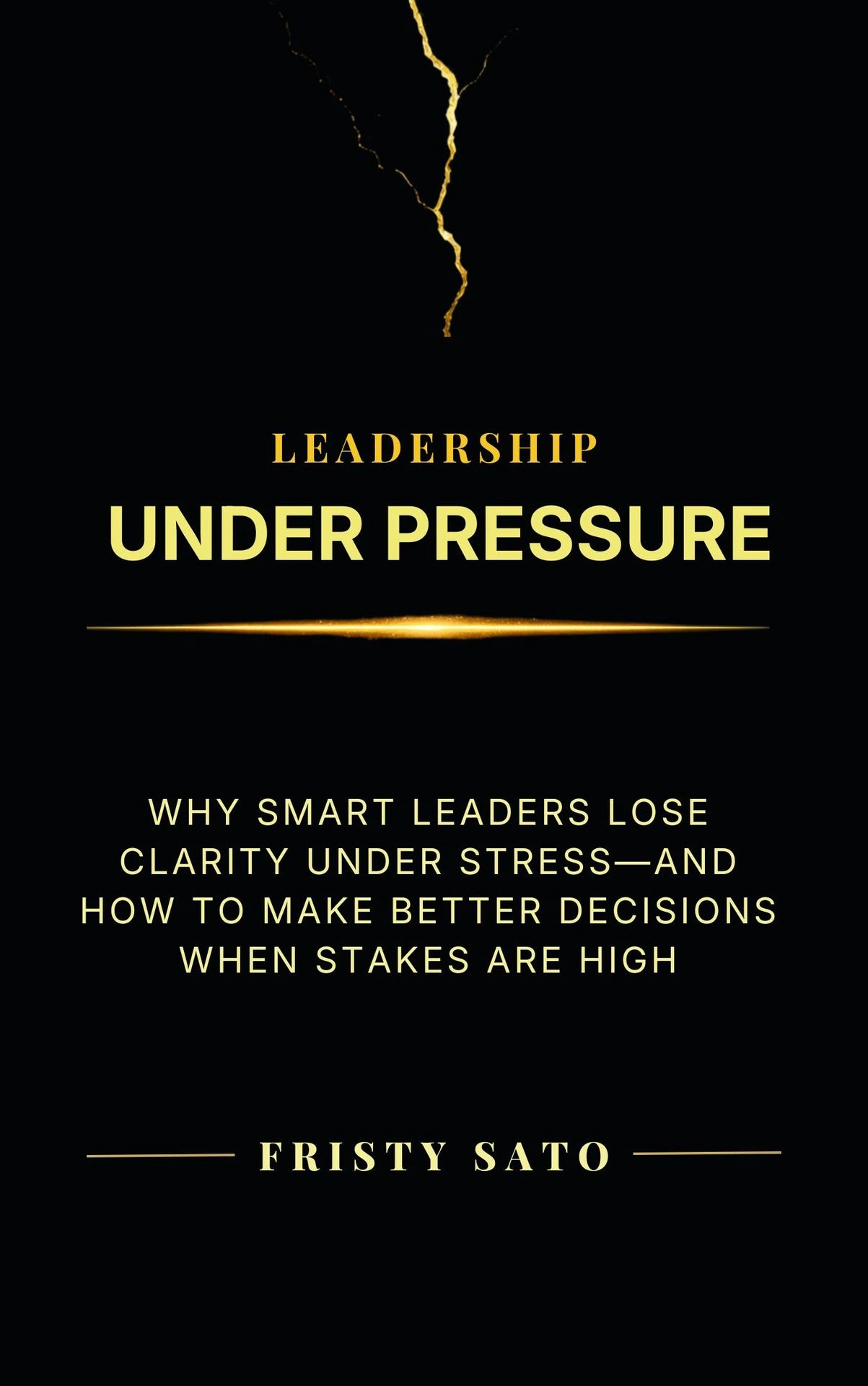
If you are ready to understand what happens to your leadership under pressure—and how to lead with grounded clarity when it matters most—this book is your next step.
"You don't need to become a leader who never feels pressure. You need to become a leader who can stay clear while pressure is present."
Discover Your Leadership Pattern
Curious how your nervous system shapes your leadership under pressure? Take the free 3-minute Emotionally Safe Leadership Assessment™ to uncover your dominant survival-based pattern, identify hidden blind spots, and learn how your internal state impacts your team's performance.
Ready to dismantle the hidden operational bottlenecks in your organization?
Book a private, 90-minute Leadership Pattern Breakthrough™ Session with Fristy Sato to map your nervous system patterns directly against your current org chart and team performance.
Continue Exploring Emotionally Safe Leadership™
If this article articulated something you have been experiencing within your own career, you are not alone. The journey toward sustainable, high-impact authority begins by exploring the underlying systems that govern how we show up.
Featured Topics