Organizations change because markets shift, technology develops, customers need something different, teams grow, or old ways of working no longer serve the business.
Yet while leaders may see a strategic decision, employees experience what that decision means for their daily lives.
Will my role change? Will I still be good at my job? Will I lose influence? Will my workload increase? Can I trust what leadership is telling me?
Change may be necessary for the organization. But that does not make it emotionally neutral for the people experiencing it.
A change can be strategically sound and still be poorly led. A good strategy does not automatically create trust, understanding, or readiness. Successful change requires both a sound plan and the human capacity to work through uncertainty.
What Is Organizational Change?
Organizational change is a shift in an organization's structure, strategy, processes, technology, culture, roles, or ways of working.
Most changes involve a mix of different forms:
Strategic change: New goals, markets, business models, or priorities.
Structural change: New teams, reporting lines, leadership roles, or departments.
Technological change: New systems, tools, automation, or ways of working.
Cultural change: Changes in expected behaviors, values, relationships, and decision-making.
Transformational change: A broader shift in how the organization operates or understands its future.
Continuous change: Ongoing adjustments rather than one major transition.
One initiative can involve several of these at once. A technology rollout, for example, may also change authority, workload, job security, and team relationships.
The formal change is only one part of what people must adapt to. The meaning they attach to it also shapes their response.
Change Management vs. Change Leadership
These are complementary responsibilities, not competing approaches.
| Change Management | Change Leadership |
| Plans the transition | Creates direction and meaning |
| Defines processes and timelines | Helps people navigate uncertainty |
| Coordinates implementation | Builds trust and commitment |
| Organizes training and resources | Listens to concerns and questions |
| Tracks adoption and delivery | Develops ownership and adaptability |
| Manages practical obstacles | Addresses the human experience of change |
Strong change leadership cannot compensate for poor planning, inadequate resources, or an unrealistic timeline. Equally, excellent project management cannot fully compensate for distrust, unclear decisions, or leadership behavior that discourages honest feedback.
Change management helps an organization move. Change leadership helps people navigate what that movement means.
Why Organizational Change Is So Difficult
Discomfort does not automatically mean a change is wrong. However, discomfort should not automatically be dismissed as resistance either.
The main sources of difficulty include:
Uncertainty: People do not know what will happen next.
Loss: Change may affect status, relationships, routines, expertise, or a valued way of working.
Identity: People may wonder whether their experience or skills will still matter.
Competence: Experienced employees may fear becoming beginners again.
Control: Decisions may be made without their input.
Workload: People must learn new ways of working while continuing their existing responsibilities.
Trust: Previous changes may have involved broken promises or poor communication.
Conflicting priorities: Leaders may announce change without removing old demands.
Unclear purpose: Employees may not understand why the change is necessary or what success looks like.
Before deciding that people are resisting change, understand what the change is asking them to risk, release, learn, or carry.
The Emotional Experience of Change
People may experience uncertainty, frustration, skepticism, grief, anger, confusion, excitement, hope, relief, or cautious curiosity.
People can experience several of these at the same time. Someone may support the organization's direction while grieving the loss of a familiar role. Another person may welcome the change but feel overwhelmed by the learning required.
The same announcement can mean different things to different people. For one employee, a restructure may create opportunity. For another, it may threaten a valued team relationship. For a manager, it may mean greater influence alongside increased responsibility.
Leaders should avoid presenting these responses as a universal sequence or diagnosing employees based on their behavior. The purpose is to help leaders ask better questions rather than make assumptions.
Resistance to Change: What Is It Telling You?
Resistance is often rich information. It generally falls into three categories:
Practical resistance: The plan has real flaws, missing resources, unclear ownership, or unrealistic deadlines.
Emotional resistance: People feel uncertain, threatened, overlooked, or afraid of losing competence or influence.
Systemic resistance: The organization’s incentives, processes, power structures, or workload contradict the proposed change.
Examples include a team questioning an unrealistic deadline, a manager delaying adoption because decision rights are unclear, or employees remaining quiet because previous concerns were ignored.
Useful diagnostic questions for leaders include:
What does this person believe they might lose?
What information or support is missing?
Is the objection pointing to a real operational risk?
Have we asked people to accept responsibility without giving them enough authority?
Does the organization's current system reward the old behavior while asking for a new one?
Not every objection is correct, and not every concern can change the decision. Leaders still need to make difficult choices.
Resistance can be information, but it is not automatically the final answer.
Psychological Safety During Change
Psychological safety is especially important when people face uncertainty. They need to be able to ask questions, challenge assumptions, report risks, admit confusion, and discuss mistakes without unnecessary interpersonal punishment.
During change, employees may need to ask:
Why are we doing this?
What happens if the new approach fails?
What does this mean for my role?
What risks have we not considered?
What should we stop doing to make room for this work?
Leaders can weaken psychological safety by treating questions as disloyalty, responding defensively to concerns, or demanding enthusiasm before people understand the decision.
Psychological safety becomes especially important when certainty decreases.
Psychological safety does not mean everyone gets a veto, all concerns must be resolved, or accountability disappears. It means people can contribute useful information without unnecessary fear.
Read more: Psychological Safety: What It Really Means and Why It Matters at Work.
Trust During Organizational Change
Trust depends on what leaders repeatedly do, not only what they announce.
Five trust-building behaviors:
Tell people what is known and what remains uncertain.
Explain the reasoning behind decisions where possible.
Keep commitments and follow through.
Acknowledge mistakes and correct misleading information.
Listen to concerns without pretending every concern can be accommodated.
Trust does not require leaders to have every answer. It requires honesty about what they know, what they do not know, and what they are doing next.
People do not need leaders who know everything. They need leaders who are honest about what they know, what they do not know, and what they are doing next.
Contrast transparent uncertainty with false certainty, vague reassurance, changing explanations, and promises leaders cannot keep.
Read more: Team Trust: What Actually Creates Trust Within a Team.
Employee Engagement During Change
Change affects employees’ sense of meaning, belonging, competence, autonomy, workload, and confidence in leadership.
Distinguish genuine engagement from outward compliance. Employees may attend training and complete new processes while privately withholding concerns or waiting for the initiative to pass.
Asking people to "get on board" is insufficient when they lack clarity, resources, or meaningful ways to contribute. Leaders can support engagement by explaining the purpose, making room for practical input, recognizing the extra effort required to learn, and protecting the capacity needed for adoption.
Read more: Employee Engagement: What Really Makes People Want to Contribute at Work.
Change Can Challenge Professional and Organizational Identity
People do not only learn new processes during change. They may have to reconsider what makes them valuable, how their team works, what expertise matters, or what the organization stands for.
A long-serving employee may feel that the experience that once made them essential is losing value. A manager may struggle to give up decisions that previously demonstrated competence. A team may interpret a new structure as a sign that its previous contribution was not respected.
Acknowledging these concerns does not mean preserving every old role or process. It means recognizing that people may need clarity about how they can contribute in the new environment.
When the way we work changes, do people understand where their value and contribution fit in the future?
How Leadership Patterns Shape Change
The way leaders behave during change often determines whether uncertainty becomes learning or survival.
Pressure can strengthen familiar patterns. A leader who is uncomfortable with uncertainty may control more. A leader who believes they must remain strong may hide their doubts. A leader who feels responsible for everyone may absorb more work rather than distribute ownership.
The seven leadership identities offer a practical lens for observing these tendencies:
| Leadership Pattern | Possible Response During Change | Potential Consequence |
| The Protective Leader™ | Tightens control and avoids risk | Slower decisions and less experimentation |
| The Strong Leader™ | Performs certainty and hides doubt | Important concerns remain unspoken |
| The Responsible Leader™ | Takes on everyone’s problems | Exhaustion and team dependency |
| The Capable Leader™ | Becomes the person who must solve everything | Bottlenecks and reduced team ownership |
| The Self-Reliant Leader™ | Handles the transition independently | Collaboration and shared learning weaken |
| The Proving Leader™ | Overworks to demonstrate competence | Unnecessary pressure and visible activity over meaningful progress |
| The Achievement-Driven Leader™ | Pushes forward before people can absorb the change | Fatigue, change overload, and reduced learning |
These are possible patterns, not fixed personality types or diagnoses. The same leader may respond differently across situations. The point is to help leaders notice what happens to their behavior when their authority, competence, control, or sense of safety feels challenged.
Internal link: The Hidden Emotional Patterns Shaping Your Leadership™.
The Personal, Leadership, Team, and Organizational Lenses
One change initiative can succeed at one level while failing at another. Examine change across four connected levels:
Personal lens: What does the change mean to each person? Consider uncertainty, identity, competence, confidence, workload, and the ability to learn.
Leadership lens: How do leaders respond to uncertainty? Do they communicate clearly, listen, make decisions, share authority, and acknowledge what they do not know?
Team lens: Can people ask questions, challenge assumptions, learn together, share responsibility, and coordinate their work?
Organizational lens: Do structures, resources, incentives, decision rights, workload, and leadership behavior support the change—or quietly undermine it?
A company may train employees in a new process while managers continue rewarding the old one. A team may be encouraged to take ownership but still need permission for every meaningful decision. Leaders may talk about adaptability while punishing mistakes.
You cannot coach people into adapting to a system that continuously contradicts the change you are asking them to make.
The Change Safety Loop™
The same uncertainty can lead to different outcomes depending on the conditions surrounding people.
The Healthy Change Loop
Clarity → Trust → Participation → Ownership → Experimentation & Learning → Adaptation & Greater Trust
As people gain useful information and see that their contribution matters, the organization becomes better able to learn and adapt.
The Survival Loop
Uncertainty → Fear → Control → Compliance → Withholding → Poor Information → More Control → More Fear
When people fear the consequences of speaking honestly, leaders receive less accurate information. They may then tighten control because they believe people are not taking responsibility. That response makes people even less willing to speak or act independently.
Leading Through Uncertainty Without Pretending to Know Everything
A simple four-part communication structure helps leaders communicate when answers are incomplete:
What we know: Confirmed facts and decisions.
What we do not know: Open questions and unresolved risks.
What we are exploring: Current work to understand the situation.
What happens next: The next action, responsible person, and expected update.
Clarity is not the same as certainty. Leaders can communicate clearly even when the future remains uncertain. Unhelpful communication includes promising outcomes that are not guaranteed, using vague positive language, announcing a decision without explaining its impact, or staying silent until every detail is settled.
You do not need certainty to communicate clearly. You need honesty about where certainty ends.
Communicating Change So People Can Understand and Act
A strong change communication plan answers ten core questions:
Why is the change necessary?
What exactly is changing?
What is not changing?
Who will be affected, and how?
What is known and still uncertain?
What decisions have already been made?
Where can people raise concerns or ask questions?
What support, training, or resources are available?
What should people do now?
When will the next update arrive?
Communication is not a single announcement. It is an ongoing process of clarifying, listening, correcting misunderstandings, and updating people as facts change. Communicating more frequently does not automatically build trust unless it is useful, honest, consistent, and connected to action.
Participation, Ownership, and Accountability During Change
People are more able to take ownership when they understand the intended outcome and have enough authority and resources to influence how it is achieved.
Distinguish between decisions leaders must make and areas where employees can meaningfully contribute. Not every decision needs to be democratic. However, people can often contribute to implementation, risks, customer impact, workflow, team practices, and possible solutions.
You cannot create ownership by transferring responsibility without transferring enough power to act.
Conditions for healthy ownership include clear outcomes and expectations, defined decision rights, appropriate authority and resources, room to question and experiment, accountability for commitments and results, and honest feedback with opportunities to learn. Responsibility without authority often creates frustration, while authority without accountability can create confusion.
Read more: Ownership and Accountability and High-Performing Teams.
Change, Innovation, and Learning
Change often requires people to test new processes, learn unfamiliar skills, and adjust when the first attempt does not work. Yet uncertainty can make leaders more controlling and employees less willing to take risks.
Organizations need room for reasonable experimentation, early reporting of problems, feedback, and course correction. Psychological safety does not remove responsibility for risk management or results.
The organization needs innovation precisely when uncertainty makes experimentation feel least safe.
Read more: Innovation and Creativity and Psychological Safety.
Change Fatigue: When People Have Too Much to Absorb
Change fatigue is the exhaustion, cynicism, or reduced capacity that can develop when people face repeated or overlapping changes without enough clarity, support, stability, or recovery.
Possible signs include employees assuming the latest initiative will soon be replaced, lower participation in training, cynicism toward leadership announcements, increasing workload, declining energy, passive compliance, and reduced trust in long-term priorities.
Fatigue is not always caused by change itself. It may come from unclear priorities, repeated reversals, poor timing, inadequate resources, or the expectation that people will add new work without stopping anything else.
People can adapt to change. They struggle when change becomes constant without meaning, stability, or recovery.
A practical question for leaders: What work, expectation, or initiative can we remove to make room for this change?
Change, Burnout, and Sustainable Performance
Transitions can increase decision load, learning demands, uncertainty, emotional labor, and workload. When organizations ignore these costs, people may temporarily compensate through longer hours and extra effort.
Distinguish short-term effort from sustainable capacity. A team that delivers a change through prolonged overwork may meet the deadline but become less able to handle the next challenge. Protect capacity by prioritizing work, allocating resources, setting realistic timelines, reducing conflicting demands, and making recovery possible.
A change is not fully successful if the organization achieves the transition by exhausting the people it needs to operate afterward.
Learn more: Leadership Capacity, Survival Based Success, Employee Engagement, and Leadership and Burnout.
How Leadership Pressure Can Undermine Change
Pressure can narrow attention and make familiar responses stronger. During change, leaders may:
Make decisions too quickly to escape uncertainty.
Delay decisions because they want complete information.
Control details rather than set direction.
Hide uncertainty to protect their image.
Take work back from people who are still learning.
Avoid difficult conversations.
Demand visible progress instead of checking whether people understand.
Push harder when the real problem is a lack of capacity.
These behaviors can produce an appearance of control while weakening the organization's ability to learn.
When uncertainty increases, does your leadership create more clarity—or more fear?
Learn more: Leadership Under Pressure, Decision Making Under Pressure, and Emotional Regulation for Leaders.
What Leaders Need to Do Differently During Change
Ten core responsibilities for leaders navigating change:
Clarify the purpose: Explain the reason for the change and the intended outcome.
Name uncertainty honestly: Do not promise what cannot be guaranteed.
Listen for useful information: Treat concerns as potential insight, not automatic disloyalty.
Make decisions visible: Explain what has been decided, by whom, and why.
Invite meaningful participation: Give people real ways to improve implementation.
Share ownership: Transfer appropriate authority alongside responsibility.
Protect capacity: Review workload, timing, support, and competing priorities.
Respond constructively to mistakes: Correct problems without creating unnecessary shame or concealment.
Model accountability: Admit when leadership decisions need to change.
Review and adapt: Use evidence from implementation to improve the plan.
Emotional safety is not about making every moment comfortable. It is about enabling people to face difficulty without unnecessary fear interfering with their ability to think, speak, learn, and contribute.
Common Mistakes That Cause Change Initiatives to Struggle
Announcing a change before leaders understand its practical impact.
Using positive messaging to cover real uncertainty.
Communicating decisions without creating channels for questions.
Treating resistance as disloyalty or incompetence.
Asking employees to innovate while punishing mistakes.
Assigning responsibility without sufficient authority.
Adding new work without removing old priorities.
Assuming training alone will change behavior.
Expecting HR to repair problems created by leadership behavior.
Measuring adoption while ignoring trust, workload, and capacity.
Asking people to become more resilient instead of addressing avoidable system problems.
Ignoring the difference between a poor implementation plan and a difficult but necessary change.
These problems are not solved through communication alone. They may require changes in resources, authority, incentives, timelines, structure, or leadership behavior.
Why Organizational Change Programs Fail
Initiatives can struggle when the organization lacks:
A clear and credible reason for change.
Alignment among senior leaders.
Consistent communication.
Appropriate resources and realistic timelines.
Meaningful employee participation.
Clear ownership and decision rights.
Trust in leadership.
Capacity to learn and adapt.
Consistency between stated values and actual incentives.
A way to respond to feedback and correct mistakes.
Implementation failure is different from adoption failure and capacity failure. A project may be delivered on time while people do not understand or use the new process. It may also be adopted initially but prove too costly or difficult to sustain.
Implementation is evidence that a change has been introduced. It is not, by itself, evidence that the organization has become more capable.
How to Measure Whether Change Is Working
Examine progress across five dimensions:
| Dimension | Questions to Ask |
| Implementation | Are the planned actions and milestones being completed? |
| Understanding | Do people understand the purpose, expectations, and next steps? |
| Ownership | Can people make the decisions and take the actions required of them? |
| Trust and participation | Are people raising risks, asking questions, and contributing useful feedback? |
| Sustainable capacity | Can the organization maintain the new way of working without relying on chronic overwork? |
Combine operational measures with employee feedback, observed behavior, workload data, and evidence of whether the new way of working is actually producing the intended outcomes.
What Is Emotionally Safe Organizational Change?
Traditional change practices—planning, communication, training, stakeholder alignment, implementation, and measurement—remain necessary. But change leadership also requires answering an additional question:
What happens to people’s ability to think, contribute, learn, and take responsibility when the organization is changing?
Emotionally safe organizational change does not mean eliminating uncertainty, discomfort, disagreement, or consequences. It means creating enough clarity, honesty, trust, participation, and capacity for people to work through those realities without unnecessary emotional threat.
Five conditions for emotionally safe organizational change:
Clarity: People understand the purpose, direction, expectations, and next steps.
Truth: Leaders communicate honestly about decisions, uncertainty, risks, and mistakes.
Participation: People have meaningful opportunities to contribute information and improve implementation.
Ownership: Responsibility is supported by appropriate authority, resources, and accountability.
Capacity: The organization has enough time, support, capability, and recovery to absorb the change.
Clarity + Truth + Participation + Ownership + Capacity = Conditions for Sustainable Change
How Emotionally Safe Leadership™ Supports Organizational Change
When companies shift direction, traditional change leadership usually focuses on mechanics. They give you communication plans, stakeholder maps, and training decks. They ask a very logical question: "How do we help people understand and adopt this new strategy?"
It is a necessary question. But it is incomplete.
Emotionally Safe Leadership™ adds a deeper layer. It asks: "What emotional patterns are shaping the way leaders respond to uncertainty, authority, mistakes, and loss of control—and how do those responses affect the people around them?"
Strategy matters. Resources matter. Market conditions matter. But the daily experience of change is largely shaped by the emotional signals leaders send. Consider how hidden survival patterns quietly disrupt organizational transitions:
A leader's intense need for control can unconsciously reduce team participation, turning a collaborative rollout into a compliance exercise.
A leader's deep fear of appearing uncertain can limit honest, horizontal communication when people need clarity the most.
A leader's over-responsibility can prevent distributed ownership, leaving everyone else waiting for permission while the leader burns out.
A leader's need to prove their competence can make experimentation feel socially risky for the rest of the team.
Conversely, when a leader responds to ambiguity with grounded presence, it creates a completely different psychological container—one where people have room to ask questions, learn out loud, and think independently.
These patterns do not replace strategy. They are simply the invisible current beneath it.
Emotionally safe leadership does not make change painless. It makes it more possible for people to face change without losing their ability to think, contribute, and take responsibility.
Building an Emotionally Safe Organization That Can Adapt
Sustainable change cannot depend entirely on the emotional awareness of a single heroic leader. If an organization wants to adapt gracefully, the wider system must actually support the behaviors it asks for.
When you build an Emotionally Safe Organization™, individual breakthroughs turn into institutional capacity. That requires aligning your daily structures with human psychology:
Clear decision rights and accountability: People cannot take ownership if they do not know where their authority begins and ends.
Trust across teams and leadership levels: Relational safety replaces political posturing when information flows without fear.
Psychological safety for speaking up and learning: Mistakes must be treated as operational data rather than character flaws.
Workload and resources that match the demands of change: You cannot restructure an enterprise while running your people at maximum capacity.
Systems that support experimentation and feedback: Adaptation requires room to test, fail, and adjust without administrative punishment.
Leadership development beyond individual performance: Shifting metrics from personal output to how effectively leaders develop their people.
Distributed responsibility: Shifting away from a culture that depends entirely on a few central bottlenecks.
Consistency between values and daily decisions: Ensuring that what leadership praises in public matches what the organization rewards in practice.
When these dimensions work together, they connect the inner world of the leader to the broader health of the workplace culture.
Sustainable change requires more than people who can adapt. It requires an organization that makes adaptation possible.
Explore more on this transition through our foundational guides on Ownership and Accountability, Team Trust, and building a truly Healthy Workplace Culture within an Emotionally Safe Organization™.
The Future of Organizational Change
Organizations today are navigating continuous shifts in technology, market demands, operating models, and customer expectations. The traditional answer has been to ask people to tolerate more change—to run faster, pivot harder, and absorb higher levels of operational stress.
That approach has a biological ceiling.
The future belongs to organizations that become skilled at learning, adjusting, sharing responsibility, and protecting the human capacity that makes adaptation possible in the first place.
We have to distinguish true adaptability from endless, reactive change. A resilient organization does not change everything constantly. It knows how to recognize what must evolve, what must remain stable, and how to move between the two without exhausting its people.
The strongest organizations are not the ones that change the fastest at any cost. They are the ones that can change intelligently, learn honestly, and maintain the human capacity to keep moving forward.
Discover the Emotional Patterns Shaping Your Leadership
Before you try to lead change differently, understand the patterns that shape how you lead when things become uncertain. Explore your baseline through the Free Emotionally Safe Leadership Assessment™.
Take a Free Leadership Course
Across five deeply engaging modules, our flagship digital course—The Hidden Emotional Patterns Shaping Your Leadership™—bridges the gap between human biology and modern business leadership.
Take The Hidden Emotional Patterns Shaping Your Leadership™ Free Course on Udemy
Deepen Your Perspective
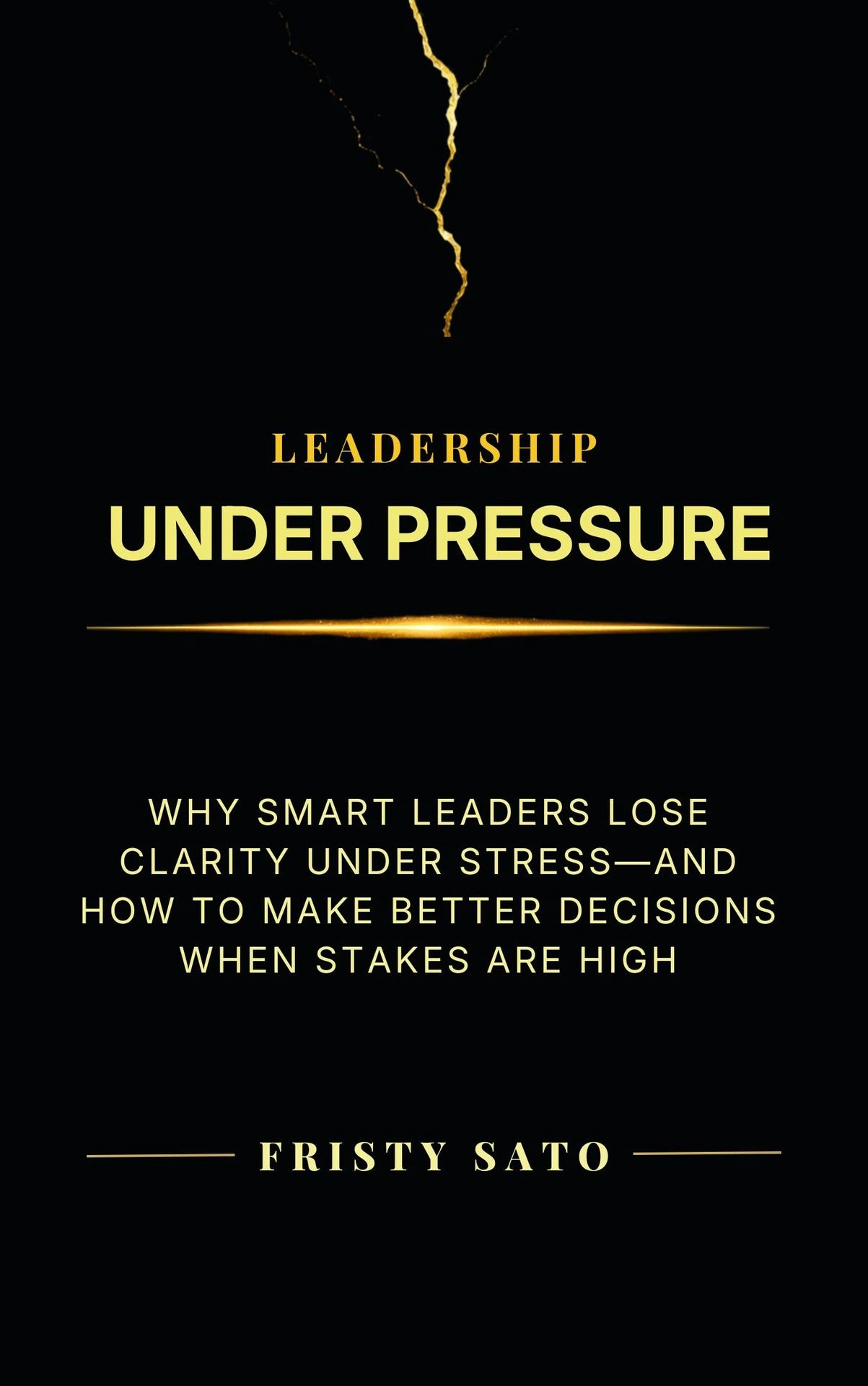
For leaders who want to maintain clarity when stakes are high, explore Fristy's book,Leadership Under Pressure: Why Smart Leaders Lose Clarity Under Stress—and How to Stay Clear When Stakes Are High.
Ready to dismantle the hidden operational bottlenecks in your organization?
Book a private, 90-minute Leadership Pattern Breakthrough™ Session with Fristy Sato to map your nervous system patterns directly against your current org chart and team performance.
Continue Exploring Emotionally Safe Leadership™
If this article articulated something you have been experiencing within your own career, you are not alone. The journey toward sustainable, high-impact authority begins by exploring the underlying systems that govern how we show up.
Featured Topics